27636 results found
The current series of notifications issued by the Central Government has the potential to create a 'police raj', under the Intelligence Bureau, when that may not be the intention even of the Union Home Ministry.
Every disruptive technology sparks excitement, investment, and the risk of a bubble—and AI is no different. Before deciding if AI dreams will materialise, the parallels between past bubbles and the current AI race need to be understood.
If there is one thing that the weekend reshuffle of Ministers and portfolios may have done for the image of Prime Minister Manmohan Singh's Government, it is to put the recent past behind in terms of political charges of corruption and non-performance.
The most critical area for India's response to climate change must be adaptation. It needs to invest in actions against the imminent threats posed by climate change irrespective of how the global discourse progresses. Investments must be made through innovative channels, using a mixture of capacity-building programmes, awareness campaigns, traditional solutions, and new technologies.
As tensions simmer between New Delhi and Beijing, some have called for India to focus on developing stronger relations with Taiwan.
The essence of any democratic system is the healthy functioning of political parties and consequently free and fair elections. Free and fair elections imply not only a legal institutional framework for the conduct of elections and a transparent electoral process.
An ORF Mumbai-SPGRC workshop has decided to launch a city-wide, age-appropriate awareness campaign to curb rising gender-related crimes in Greater Mumbai municipal corporation schools. It would try to sensitise children about sexual harassment and other gender-related crimes.
The Narendra Modi government's 'Make in India' campaign, on the whole, seems out of sync with today's world where it doesn't matter where a product is made because even high exporting countries like China basically assembles parts made elsewhere in the world.
The Press Council chairman is spot on as far as the media's coverage of Muslim terror is concerned. He is equally right on the market driven focus on Formula 1, Lady Gaga, Mettallic group, bollywood gossip, fashion, etc in a country where the majority are poor.
ASEAN and India will need to adopt a more inclusive and pragmatic approach towards Myanmar — one that involves all key stakeholders
In early 2020 the Islamic State of Iraq and Syria (ISIS) published an India-centric propaganda material called Voice of Hind. This special report examines the first issue of the publication, which openly recruits Indian Muslims by manipulating the fears and grievances they harbour owing to certain political developments in the country. The analysis uses theories of social psychology, inter-group conflict discourse, and communications theory to pr
Economic sanctions are often seen as an alternative to war, but they do not always have the desired effect. This brief argues that for such sanctions to be effective, economic interdependence must be established, economic rationality must outweigh political ambition in the sanctioned country, and the message of the sanctions must be clear. Using the sanctions against Russia as an example, this brief contends that because of the interdepen
The elections in Sweden are maybe a last reminder that the EU needs to renew its foundational narrative.
There is no easy answer to the question of how best to balance all the competing water use priorities of the Ganga. But one thing is clear: as long as rivers are seen merely as pipes for conveying water, and challenges of distribution are addressed primarily through engineering rather than policy, then no solution will be appropriate.
Bringing the private sector centre-stage requires a sea change in the manner of its participation and its role in nation-building.
The deal with Iran should boost efforts to do an Iran with North Korea's nuclear programme as well. This would be more difficult given the authoritarian nature of the regime in North Korea but is still an idea worth pursuing. The major powers should carry forward the momentum and energy to solve other issues in the Middle East.
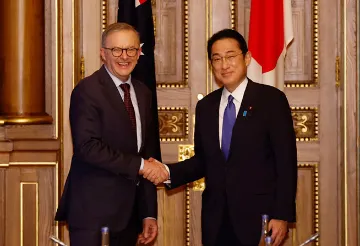
Energy, technology and policy drive New Delhi-Tokyo collaboration
At this point, EU-India cooperation on climate is hampered by conflicts about the EU's CBAM and limited engagement in COPs. FTA is not the right forum to change the dynamics of discussion on trade-related climate measures.
With the EU being India’s largest trading partner and the second-largest export destination, the economic logic of strong India-EU economic relations is self-evident. The two sides have also agreed to commence talks for a standalone investment protection pact and an accord on geographical indications
As Chinese economy is facing its worst slowdown in recent times, for Africa, Modi's new India might turn out to be the one viable alternative to China. Therefore, the upcoming India-Africa Summit will be an occasion to harness this opportunity and seek a meaningful strategic engagement beneficial to both the countries.
India's agriculture has not grown fast enough to support the growing rural population and there has been a continuous exodus of people migrating from villages to towns in search of jobs
Engaging the Myanmar Army in exercises such as those with India provides an opportunity for Myanmar Army officers to learn from the experiences of other armed forces in international military operations.
Noted sports writer Mr. R. Mohan says that India could host the Olympic Games from 2030s if it learns to stick to schedules and avoid scandals, which had brought bad name initially in the case of the Delhi Commonwealth Games.
The list of China's signs of displaying its assertiveness in the South China Sea is numerous - like the incident with the Japanese coast guard and the USNS Impeccable. The Pentagon accused the Chinese vessels of "harassment" during the US ship's routine operations in international waters.
Despite New Delhi’s continued hopes and some encouraging signs, significant challenges remain.
Iran represents a complex policy challenge that needs to be carefully weighed. Any assessment will need to look not only at the benefits but also the costs of not changing course on Iran. But fence-sitting and procrastination might be an unsustainable and expensive choice.
A VERY recent multiauthored paper titled ‘Mapping the world’s free-flowing rivers’ has been published in the journal Nature.
In Sri Lanka, whoever wins or loses the parliamentary polls, and whoever forms the government afterward, it's President Maithripala Sirisena who would be at the centre of all post-poll politics over the ethnic issue, political solution and 'accountability issues' of the UNHRC kind.
Australia's Murray-Darling example is not a panacea for the basin-wide river management of the Ganga. And it is not through lack of international role models that a genuinely holistic, basin-wide approach has not been applied to the Ganga; it is through a lack of domestic political will to do so.
If Narenda Modi could turn around Gujarat's agriculture so dramatically, he can be instrumental in turning around agricultural productivity, marketing and storage in all States. He has to act quickly. Otherwise, there would be more problems of large scale migration from the rural to cities.
All that the government has to do is to focus on providing basic goods -- high quality primary education and healthcare, toilets and housing for all. When there is so much money in India in private and public hands, why is it taking so long for the government to do something to change the lives of millions of people?
Taliban's origins are very much in the Pakistan's State agencies and hence it cannot be called a non-State actor. It is too large and too fragmented to be taken up as one enemy. For PM Nawaz Sheriff to declare that there is 'no good or bad Taliban' is just an empty rhetoric and still part of the same old double-speak.
Conflicts in the Middle East have been exacerbated by competition over natural resources. Within the United States, there is growing bipartisan interest in reducing dependence on foreign oil.
Arguably the most ambitious health insurance programme in the world today, the Pradhan Mantri Jan Arogya Yojana (PMJAY) gives India the chance to transform its healthcare infrastructure. Launched in September 2018 and foreshadowing the general elections of 2019, PMJAY is equal-parts political and economic. It aims to address the healthcare needs of India’s poorest 100 million households and has the potential to deliver what its predecessors ove
AUKUS adds another layer of deterrence against China. The group is likely to strengthen the military dimension, contrary to the belief that it undercuts Quad.
Russia's military intervention in Syria in September, 2015, is a new gambit by its president, Vladimir Putin. It could change the course of history, and even geography, in that region or bog down Russia in a West Asian quagmire.
The post-pandemic Indian economy could resurrect itself by prioritising Sustainable Development – as the SDGs not only embody various capitals, but also hold immense potential for business opportunities. This needs to be realised through global partnerships and more private sector involvement in the domestic economy.
Compared to India and Norway, South Africa may have entered Sri Lanka first and re-entered now to a relatively positive start, or so it seemed. Their timing now proves to be wrong, and their proposals thus may not either be heard, or acted upon.
Governments across the world are reluctant to cede power to the city-capitals, but with Delhi being larger than many states in India, it needs to have a relook at its relationship with Centre
The contradictions in the path of India's global rise and its accompanying stature as an important player in international affairs, while it grapples with issues of food security, rising prices, inflation and governance challenges, were highlighted by senior academician Dr. Mira Kamdar at a talk titled "Can the Centre hold?" at Observer Research Foundation recently (February 17).
Despite India’s recent seeking of friendlier ties with Beijing, the future prospects for relations remain uncertain.
Given the quantity of investments, China can’t afford to have the OBOR initiative fail. Sceptics like India can use that to persuade China to make modifications.
A common enemy does often become a powerful uniting force, but the fact that the US has so many friends and not a single ally to fight the Islamic State speaks volumes about its foreign and defence policies in Wes Asia.