27704 results found
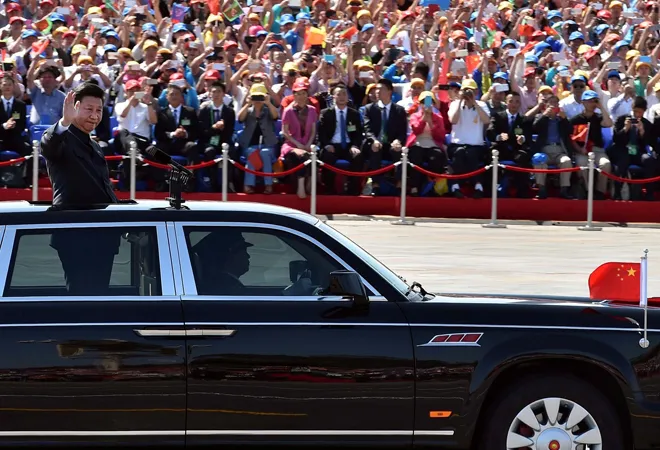
In two sets of visits to the Central Asian region in 2013 and 2014, Xi Jinping set a scorching pace for Modi to follow. Unfortunately for India, even a super-star Prime Minister cannot do the impossible. He lacks the vast investible resources that China has already deployed and is deploying in the region.
The geopolitics around India’s play in Chabahar and Iran’s leverages are interesting
During the Cold War, India navigated its external relations guided largely by the doctrine and practice of non-alignment. In these contemporary times, the COVID-19 pandemic is likely to inaugurate a period of heightened geopolitical rivalries, with the United States and China as the principal poles. India will be differently positioned in this post-Covid “new normal” than it was in the era of the Cold War and therefore will need differe
The changing world order in the post cold war era has heralded the rise of economic globalization which has been dominated by the desire for symbiotic cooperation and economic intercourse between states.
While the issues are tricky for the UK, the EU is also in a difficult position with the wider EU under stress.
China has persistently employed a strategy of belligerent operations below the threshold of war against its territorial and maritime neighbours. These range from fistfights with neighbours’ armies and minor troop engagements on land, to ramming ships against theirs in its near seas, clashing with their coast guards, or engaging in aggressive military exercises and aviation patrols. These actions are not severe enough to provoke a war, but not s
In an email interview with ORF Pakistan Studies Programme, well-known expert Hassan Abbas discussed a variety of issues about Pakistan. Dr Abbas, a fellow at Harvard University's Kennedy School of Government,
The emancipation of the Dalit is an even more recent phenomenon in North India. Hence the inability to stomach any comical casting of the solitary Dalit icon, B.R. Ambedkar.
The Afghan-Pakistani region is in transition and the changing geo-political realities will have new implications, says Kamran Bokhari, Vice President of Middle Eastern and South Asian Affairs at Stratfor. He says old paradigms cannot be used to gauge new realities.
Digital labour platforms—or online marketplaces that connect work providers and work seekers—will undoubtedly help shape the future of work. This brief studies the platforms targeted at online gig workers (or freelancers), who use them to find digital work opportunities in their home market or elsewhere, and then produce and deliver their services remotely. The brief explains the underlying technological and economic drivers and how the Covid
Over the last few decades, particularly after the end of cold war, a distinctive feature of the strategic and security related environment has been the unprecedented and sheer dynamics of change in the concepts, paradigms and complexities of national, regional and global security.
During the past couple of weeks, Nepal Maoist chief Prachanda has given three significant interviews. He carefully picked up three influential and understanding media channels, ¿ Kantipur in Nepal, The Hindu in India and the BBC of London ¿ to send a strong message across to Nepal, India and the international community respectively.
Amid rising oil imports, persistent urban air pollution, and mounting emissions, India’s shift to electric vehicles (EVs) is no longer optional; it is essential. This paper explores India’s evolving EVs landscape through the lens of its climate and energy security goals, with a focus on the often overlooked but critical role of charging infrastructure. It assesses current adoption trends, evaluates the effectiveness of key policies, and ident
India-Bangladesh relations got a major boost following Home Minister P Chidambaram's visit to Dhaka in July this year. The visit, described by Chidambaram as constructive, infused optimism about the resolution of some of the bilateral issues like border during Prime Minister Manmohan Singh's scheduled visit to India in September this year.
Over the last five years, Brexit, the victory of Donald Trump in the US and the assumption of power by Xi Jinping in China, the seizure of Crimea and the Ukrainian crisis, the South China Sea disputes, and the emerging Iran crisis, have all helped upend the world order. Amidst these crises, the surge of Chinese acquisitions and investments in Europe did not draw much attention. The acrimony, however, between China and the US on trade and industri
While Nepal has signed up for a rail link with Tibet, it stands to gain more from projects with the Indian Railways.
The challenge will be how India and other countries use this opportunity to restore strategic balance in the region.
India and Japan unite over Beijing's moon landings and antisatellite weapons
For decades since 1932, after the Chakri dynasty gave up absolute power, Thailand has lived under the shadow of military coups.
There is public anger against China and a dominant feeling that China has to be stopped before it succeeds in changing the status-quo on the India-China boundary
New Delhi must sharply raise its preparedness to deal with a Beijing that seems bent on aggression
With the traditional liberal order appearing agile, new questions on international security and peacemaking have come to the fore. In the current context, global players are according Afghanistan greater strategic importance. As NATO troops continue to make headway in that region into the safe havens of ISIS, and with US posturing purportedly getting more robust, China’s role in Afghanistan merits scrutiny. Even though China’s involvement, mi
Chinese influence in Africa is high on the global agenda, as China within just a few decades has become a key political and economic power in the continent. Indeed, its emergence as a dominant economic and political actor might be the most important development in Africa since the end of the Cold War. This paper analyses China's economic and political relations with Africa beginning in the 1990s. It argues that the concern is not that China has e
The fifth meeting of the Forum on China-Africa Cooperation in Beijing was used by China to reinforce its engagement with Africa. It is significant that despite it being only a ministerial conference, six Heads of State and two Prime Ministers attended the opening session.
The last India-Africa Forum Summit took place in New Delhi way back in 2015, and significant shifts in global geopolitics and geoeconomics have occurred since then.
India has seen a huge jump in screen time by 25 per cent (4.9 hours pre-COVID to 6.9 hours) during the pandemic.
The response to the country’s new defense budget suggests that Beijing continues to be tone deaf to regional anxieties.
As the gap between its power and that of China grows, India needs the US to balance China in the South Asia-Indian Ocean Region. The Indian contribution, military or economic, towards a strong American Indo-Pacific strategy appears more nebulous. This is an asymmetry which cannot but have real-life consequences. India should not assume that antipathy to China alone will be the over-riding factor in the US global policy.
But Covid is likely to accelerate technological decoupling with the US
Beijing’s move, though unsurprising, is not without significance.