27844 results found
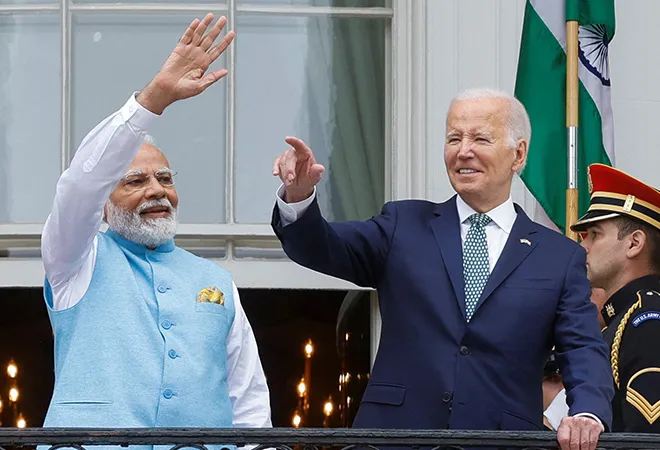
Modi’s re-election assures India’s allies that Delhi will play a leading role in shaping the new world order
India and Pakistan could demonstrate their responsible stewardship of nuclear weapons by launching a bilateral initiative on HINW.
Ensuring contestability and fairness in India’s digital market—one of the world’s most prominent—is critical to ensuring consumer welfare. This paper outlines a legal and regulatory framework that can ensure contestability and fairness in the Indian digital market. The paper identifies the following elements of this toolkit: (i) competition law; (ii) ex-ante regulation for digital gatekeepers; (iii) laws for increased transparen
PM Modi's official visit to the UK is unexceptional. This is despite the hype and hoopla that accompany any Modi tour. However, what was different was that for the first time Modi had to respond to issues like Gujarat 2002 riots and the climate of intolerance back home.
A more concerted and intensive engagement will serve both India and Indonesia well
The closing months of the year 2003 saw a change in the language of the discourse emanating from the Pakistani establishment in general and its military dictator Gen.Pervez Musharraf in particular
A strong alignment between India and Indonesia holds the key to Delhi's much-vaunted "strategic autonomy" and Jakarta's quest for a "dynamic equilibrium" in Asia. It will also set the template for India's security cooperation with other regional powers in Asia.
Liberalisation has given birth to two Indias. One which is prosperous and living first world lifestyles and the 'other' in which people are living without human dignity and suffering multiple deprivation. Regional disparities have also led to disparate standards of living.
The Munich Security Conference Core Group Meeting is beginning in New Delhi from Tuesday. Around 70 senior decision-makers from politics, business, media and civil society from India, as well as the Euro-Atlantic, Asian and the Middle East region will discuss key issues of international security policy.
Pragmatism has finally taken root in Delhi and Kathmandu — project implementation will be the test
It will be its second foreign military base, after Djibouti, which was set up in August 2017. China clearly is looking at the longer term.
The rapid pace of digitalisation poses new national security risks for countries like India, a country with over 700 million internet users. The multilayered digital ecosystem comprising of infrastructure, devices and applications is complex, and security threats evolve at a breakneck pace. This makes it difficult for states to develop an effective response to individual or organisational security threats. India therefore has often had to resort
The US and India no longer seem diffident about joining hands to counter the rising influence of China
The US won’t play its post-World War II role. What happens next will depend on others’ responses
In February 2004, President George Bush outlined his new nuclear non-proliferation approach, in his ¿seven points¿ speech at the National Defense University. It include the setting up of proliferation security initiative which will control and monitor not only shipments and nuclear transfer of material/technology but also will be empowered to take direct action against the violators of the law.
Global powers like the United States and China have spared little effort in attempting to shape the digital age in their image. At the same time, other powers like Japan and France, and emerging ones like India aim to play a part in building the global digital ecosystem. These latter three share similar values: democracy, freedom of speech, open access to digital resources, and sovereignty. They all desire to keep the digital commons intact and n
A new social contract between citizens, consumers, employees, the state, and enterprise is needed to delineate a new understanding around rights, responsibilities and entitlements. Digital transformations are rapidly altering the nature of work, models of employment, contracts, regulations and protections. Increasingly, the responsibilities of the state are becoming the obligations of,�
US foreign policy is steadily renouncing multilateralism while China is stepping into its shoes
As India redefines its priorities vis-a-vis China, its policymakers will have to be bolder in articulating the need for robust partnerships
As the foreign secretaries from India and Pakistan try this week to sustain the peace process amidst growing mutual suspicion, the Siachen question offers one potential area where recent progress could be consolidated. Discussions on the demilitarisation of the Siachen conflict zone have been proceeding slowly but surely towards a political agreement, even though the pace is too gradual to satisfy pragmatic analysts in both countries.
Notwithstanding the euphoria, Alexei Navalny is unlikely to be the catalyst that will lead to ‘regime change’ in Russia
Beijing’s position paper, on its policy in Afghanistan, is reflective of its recent efforts to present China as a nation that is now heavily invested in addressing ‘international hot button issues’
During the meeting between the home secretaries of India and Bangladesh held in October this year, Bangladesh agreed to sign an extradition treaty and there has been major progress on this regard.
The first few weeks of Afghan President Ashraf Ghani's tenure has seen a flurry of diplomatic activity. The steps taken by him in the foreign policy domain give a clear indication of the new government's priorities.
Most central banks across the globe are today seized with the idea of cryptocurrency, with countries like Sweden and China already embarking on their pilot projects. This paper argues that most of the proposed architectures for a Central Bank Digital Currency (CBDC) are not designed to mimic the paper currency in its digital form. It proposes an architecture that largely retains all the properties of a paper currency, with only one limitation—i
Evidence from several countries suggests that last-mile connectivity solutions—the transport options available to commuters from the origin of their journey to the point of accessing a public transit system—enhance citizens’ mobility and increase metro rail ridership. This brief evaluates India’s operational metro rail transit systems to identify the missing links in the provision and effective implementation of last-mile connecti
The onset of the COVID-19 pandemic hastened the widespread adoption of digital technologies across the globe. The pace of digitalisation—from the micro levels of education and e- commerce to the macro levels of supply chains and production networks—has galvanised governments to advance digital regulations. The tightrope walk of creating policies that enable digital innovation and ensure regulations are in the larger public interest have led t
It was China’s disruptive aggression that made its four members issue such a direct joint statement.
India presents more immediate potential for the "top line" obsessed Silicon entrepreneur. But Asian companies from Japan, China, and Korea in sunset industries, are better placed to be responsive to the fragmented Indian market than a Fortune 500 corporate, which survive on scale not agility.
Russian President Vladimir Putin is scheduled to visit India in December 2025. The outcomes of the annual leaders’ summit will be largely determined by how India untangles the trade spat with the United States.
Pacific Small Island Developing States (PSIDS) are highly vulnerable to disasters emanating from the impacts of climate change, geopolitical tensions, and fluctuations in global energy markets. To overcome this, the PSIDS have committed to ambitious carbon reduction targets, and to adopting renewable energy and low carbon emission initiatives. However, they must contend with critical barriers, such as the lack of finance, capacity, and te
The European Union (EU) stands at a critical junction in its institutional evolution. The European sovereign debt crisis in 2009, the Brexit decision in 2016, and the success of anti-European populist parties in many member states have triggered intense discussions about necessary reforms in the Union, which only intensified after Emmanuel Macron became president of France in 2017. His vehemently pro-European outlook and ambitious suggestions for
Is India stepping into global and regional leadership mode?
US commitment to Asia-Pacific security is evident in the ‘Aukus pact’ that will see it share nuclear technology with Australia
What is the measure of success for the Space Code of Conduct, or more substantially what is different about this Code effort that distinguishes it from the last? If the Code of Conduct fails to attract signatures of key players will its success be taken into question?
Despite one-fourth of people living away from where they were born, no arrangements exist for domestic work migrants to vote from where they work. But enthusiasm abounds for facilitating NRIs to do so.

Trump’s unique ability to marginalise the US’ partners and placate its adversaries shapes the Ukraine war.
India has been witnessing rapid urbanisation in the last decade, particularly in its large and medium-size cities. As more and more people move towards cities and towns, it is imperative to build an understanding of how cities are geared in terms of growth and inclusion. In what ways do India's marginalised communities get excluded from the country's growing urban spaces? This paper studies how individuals and groups are included inor exclude
Last week India hosted two important visitors – Russian foreign minister Sergey Lavrov, and the US special presidential envoy for climate John Kerry. These were routine visits, one to lay the groundwork for a potential Russian presidential visit to India and the other to assess Indian intentions on climate
With a trade deal unlikely, New Delhi must calibrate the costs and benefits of the U.S. President’s political tour