27863 results found
The Bohai Shipyard, located in Huludao in Liaoning province, China, is the country’s only shipyard engaged in the construction of nuclear submarines. The yard has expanded since its inception and is poised to grow further in the coming years. With some of the new facilities having already been commissioned, there has been a considerable increase in the throughput of the yard. This report examines the augmentation of facilities at the Bohai ship
If we accept the US to do something for us, we too have to be able to offer a quid pro quo, remembering that in international relations, national interests are supreme, sovereignty is (sometimes) equal but power and reach are not equal.
One of the most awaited and celebrated events of 2010 in India was the State visit of US President Barack Obama from November 6-8. Considerable amount of discussions and debates had taken place both before and during the visit.
Indo-US relations that have witnessed a remarkable transformation in recent years, both in tenor and substance, are under intense scrutiny on the eve of US President Barack Obama's forthcoming visit to India. While relations between the two democracies have moved from one of 'estrangement' to a relationship of 'engagement' at many levels, there are outstanding issues that need to be addressed. This Issue Brief explores the prospects for cooperati
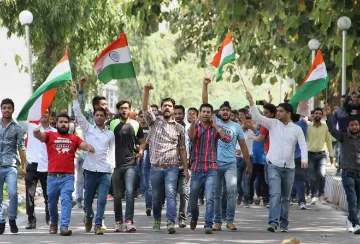
Pakistan is cornered after India revoked Article 370. But it is still a time of great caution for India. We must watch the neighbour's moves, his begging bowl in one hand, dagger in the other.
While NYAY is a great scheme on paper, it probably needs more consideration.
Ahead of polls, he will seek to leverage the trip for political ends. India should stay focused on the wider agenda
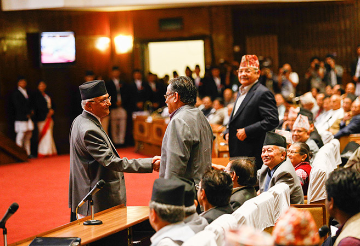
Once Narendra Modi steps away from the minefield of Nepal's domestic discourse on the Hindu state, the Indian Prime Minister will find the shared Hindu and Buddhist heritage a solid foundation on which to build a new and lasting edifice of bilateral cooperation.
Notwithstanding Pakistan’s best efforts to steer the Pulwama narrative to its advantage, what should worry us is the political orchestration that has not ceased yet.
The hyped jingoistic ‘surgical’ action did nothing to deter Pakistani ‘misadventure’
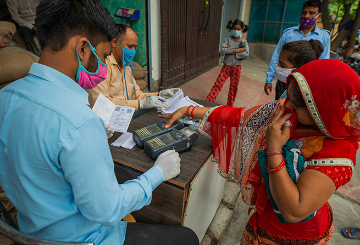
Direct criticism for scarce or expensive vaccines at the government, not the private sector
Transboundary water politics in the Ganges-Brahmaputra-Meghna basin areaffected not only by inter-government relations between India, Nepal, Bhutan and Bangladesh,but also by dynamics on different scales, including the hydropolitics between Indian stateswithin the basin. At the same time, the disputed issues, and the patterns of power dynamicsbetween actors, are similar in transboundary interactions in the basin as well as in inter-stateinteracti
The global health landscape is undergoing dramatic shifts, none of which are conducive to mitigating urgent health issues that affect large populations across the globe. In particular, the United States (US) will likely slash its multibillion-dollar contribution to Gavi, the Vaccine Alliance, the international public-private platform that seeks to increase access to vaccination in low- and middle-income countries. This brief outlines the potentia
The terrorists may be an extreme minority, but they have successfully coerced the majority?or, to be more accurate, enthralled them?into sympathy for them. They have successfully also intimidated a large number of writers, artists, journalists, film-makers, many of whom live in exile.
Whether it is the Quad, BRICS or the SCO, India is the odd man out.
His party claimed to be different from the effete government led by the Congress and its foreign policy therefore needs to be held to a higher standard.
The Modi government needs to break from traditional, statist methods of conducting water diplomacy and distinguish itself by including the concerns of basin inhabitants on both sides to find a lasting solution to the Teesta issue.
Relentless urbanisation often has a heavy environmental cost, arising from activities such as the consumption of fossil resources to fuel industrialisation and infrastructure development. The resulting surge in greenhouse gas emissions is one of the biggest contributors to climate change, which leads to frequent extreme weather events such as floods, droughts, and heatwaves. Such events pose an existential threat to human life, infrastructure, an
Qatar is creating a large footprint for itself in the West Asian Qpolitical landscape. The Gulf state was previously known primarily for its oil and gas reserves, and compliance with US interests in the region. However, Qatar has in the recent past made significant efforts to assert regional pre-eminence through an aggressive foreign policy. Emir Shaikh Hamad bin Khalifa Al Thani, who recently handed over the reins of power to his son, Tamim bin
Growing space security threats are proving to be a challenge for existing global governance measures, but consensus on new rules is proving difficult.
As new geopolitical and geo-economic realities emerge in the Indo-Pacific, India is now a critical node in the emerging network of variable geometries in the region. There are important opportunities in the evolving dynamic for New Delhi, as new alliances are crafted and new goals enunciated.
It has overcome sceptics to widen its ambit of partnership and also set a focused strategic agenda
The group’s big challenge is to define the security dimension of its agenda more robustly even as economic talks get underway
The Quad has been repeatedly criticised for supposedly lacking a maritime security agenda. These views, however, stem from a narrow interpretation of ‘maritime security’—one that focuses primarily on militarisation. Yet, the maritime security challenges in the Indo-Pacific remain complex and multifaceted. A closer examination of the Quad’s maritime security agenda reveals that the group has emphasised sustained cooperation on maritime sec
The President of Pakistan had expected his handpicked Prime Minister, Mir Zafarullah Khan Jamali, to perform his bidding and strengthen his position. But President Musharraf was disappointed. He, therefore, felt that a change was essential in order to secure his own place and keep the other power players content.
¿Arise, ye Arabs, and awake!¿ was the seditious 19th century slogan of Arab nationalism in its infancy. It aroused them against the Ottoman rule but did not hinder the subsequent imperial designs of Britain and France. The moment of liberation became the start of newer forms of dominance.
It is not just the art on offer that can be categorised as “political” — but also the platforms.
There is a growing clamor about India's decision to opt-out of the RCEP. While many experts say Indian SMEs stand to gain a lot if India signs the deal, others say it is likely to hurt Indian manufacturing.
This brief examines India’s relations with Pakistan and China using the lens of Kautilya, the ancient Indian strategic thinker—and argues for pragmatism: assessing the basis and severity of the threats, searching for possible strategic opportunities amidst the risks, and overall, avoiding the scenario of a two-front war. It begins by acknowledging that Pakistan and China view India through different prisms: for Pakistan, that of ideology; and
Afghanistan fell to the Taliban in August last year and since then, serious security concerns have arisen for India. There is the spectre of terrorist groups in neighbouring countries gaining strength; there is also the threat of Indians travelling to Afghanistan to either live as civilians desiring a home under “Islamic rule”, or else fight alongside terrorist groups. Indeed, other South Asian countries such as Bangladesh are reporting that
The effective total emissions, social costs, higher electricity prices, and loss of energy caused by production, transport and storage of electricity need to be included in any calculation.
Historically port cities, such as Mumbai, Chennai, Kolkata and Kochi, have been gateways to the world, fostering cultural exchange, commerce, and innovation. Today, they hold the potential to become centres of finance, services, and human talent
The elections of this motley crew, with their limited interest in liberalism, has been dubbed the ‘rise of the right’ across the world.
As the global debate on the Chinese model, and especially its domestic political system intensifies, there is a tendency to regard the Chinese Communist Party (CCP) as a monolith. This paper corrects such a view and argues that any attempt to comprehend elite politics in China requires an understanding of the factional dynamics within the party. The paper outlines the evolution of factional politics in China, and shows how two factions – the Sh
Feminist movements have historically lacked inclusivity, often growing within a limited Western upper-class psyche, based on their own challenges and needs. The digital revolution has paved the way for a new iteration of feminism. The digital space can bolster feminist activist movements by encouraging inclusion and improving accessibility in organising collective action. It also helps weave local stories with global narratives to highlight commo
This paper analyses historical trends in women’s participation in Indian democracy as voters, contestants, and legislators, using data on state assembly elections between the first one in 1951, and 2019. The paper finds that India is witnessing a strengthening of its democracy as measured in terms of an unprecedented growth in the political participation of women in these three roles. In these 73 years of Indian democracy, the turnout of women
The mass exodus of the Rohingyas from Myanmar to Bangladesh in 2017 has caused ramifications in the two countries’ bilateral relations. The underlying currents between the two nations have become more apparent following two failed repatriation efforts since the exodus. The public display of dissatisfaction and blame-game have only fuelled the tensions. This brief examines how far the Rohingya issue has affected the connectivity, trade and secur
This brief discusses the role of Artificial Intelligence (AI) and digital technologies in meeting Africa’s development goals and argues that, for tech to make a real contribution to human development in the continent, the process of technology development should enable African agency. The brief explores how AI and digital technologies can provide pathways to empower African communities, emphasising context-driven innovation and collaborative ap