-
CENTRES
Progammes & Centres
Location
4649 results found
The current Just Energy Transition Partnerships framework does not work for India because it prioritises G7’s agenda and overlooks our specific energy transition needs and challenges
Israel believes that the use of force is essential to stopping Iran from making the nuclear bomb. A vocal section of the strategic affairs community in the United States agrees with the proposition. This brief argues that military means are unlikely to sabotage the nuclear weapons programme of an advanced-stage bomb-seeker like Iran. Moreover, use of force could be counterproductive as it can incentivise Iran’s pursuit of the bomb, and it may e
In government, Prime Minister Narendra Modi needs to disrupt the lethargy of the Lutyens communication machinery by introducing some of his young campaign team into the mix. He needs to reinvent and revitalise #NaMo in his new role as PM.
The agriculture sector’s contribution to India’s GDP and employment makes it crucial to the country’s growth. At the same time, the sector’s massive greenhouse gas emissions pose a threat to India’s green transition. The ongoing farmers’ protests also highlight the need for a climate-smart agriculture strategy that will address fundamental issues like income support. This brief outlines a framework for India’s “new green revolutio
There is an irony in the government's crackdown on Ford Foundation that seems to have escaped most observers. In the 1960s, the principal critics of the Foundation were the Indian Left. Now, the government and critics of foundations and NGOs fail to realise one thing. Now we are a self-confident, resilient society with institutions that have gained considerable depth. We are also a transparent and open society.
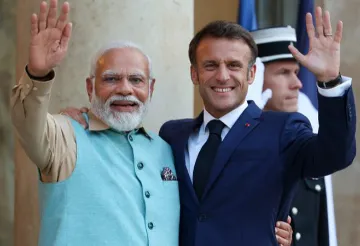
This is a partnership that has been forged amid common challenges and shared strategic objectives
Iran’s oil sales are at a five-year high as the US looks the other way despite sanctions. Iran is smartly undercutting Russia in selling cheaper oil and upset Saudi Arabia’s plan to profiteer from production cuts. The new world order being shaped amid the US-China battle for global supremacy equally belongs to countries charting independent paths
With its higher speeds, ultra-low latency, and massive connectivity capabilities, 5G technology represents a new era in telecommunications that promises to redefine industries and everyday life. Chinese telecom companies have taken the lead in developing and commercialising 5G technology, threatening the commercial prospects of Western telecom firms and giving rise to fears of surveillance and espionage. The open radio access network (O-RAN) is a
Climate change is a global commons problem requiring concerted actions by all. While recognising this, the United Nations Framework Convention on Climate Change has also acknowledged the principle of ‘common but differentiated responsibilities and respective capabilities,’ which assigns greater responsibilities to developed countries in mitigating greenhouse gas (GHG) emissions and reducing their carbon footprint. There have also been deliber
India’s relations with West Asia is among the country’s successes in foreign policy under Prime Minister Narendra Modi. One country conspicuous in its sub-par engagement with India, however, is Iran. This brief makes a case for a reset in Iran-India relations under Iran’s newly elected president and PM Modi’s third term. It examines the options and opportunities available to the two countries, and explores the recent changes in the region
Like in some other regions of the world, the COVID-19 pandemic accelerated external debt accumulation in Sub-Saharan Africa (SSA). This could have massive, adverse impacts on growth as governments prioritise debt servicing commitments over key development expenditures such as healthcare and education. For the countries in SSA with relatively lower GDP, this could mean getting caught in a vicious cycle of low output and mounting debt. A pa
The energy transition is entering a critical “middle phase” where global priorities around climate action, economic growth, energy security, and equity intersect. The political landscape must navigate a careful balance between climate imperatives, broader sustainability and development goals, energy security, affordability, reliability, and industrial competitiveness. This complexity is shaping policy debates, technology investments, politica
The real story for strong India-Australia relations lies beyond uranium. With one of the world's strongest mining sectors, Australia can help India exploit its own natural resources in an environmentally sustainable way and thereby address one of the major current constraints on India's economic growth.
More than ever before, the United States needs the continued support of the European Union (EU) in defence and security matters, especially in the war against terrorism. A draft security strategy prepared in June 2003 by Javier Solana, the EU High Representative for the Common Security and Foreign Policy (CFSP) delineated the threats to security in Europe; international terrorism, proliferation of weapons of mass destruction and failed states.
The Narendra Modi government has shown signs that it doesn’t mean to let Trump’s stance on Iran derail the oil trade with it
Iranians take their soccer seriously. Iran's victory over Bahrain last week in the World Cup qualifier resulted in an outburst of rejoicing rarely seen in Teheran. Men and women (some without head scarves) danced on the streets and tore up posters of candidates in the June 17 presidential elections. The police did not interfere. Credible foreign observers have not confirmed reports of police brutality carried by some opposition news channels in t

In order to achieve the SDGs, it is time to re-evaluate the global patents regime. India and other developing countries need to explore policies and practices for creating a culture and system that encourages innovation.
Digital technologies have the potential to annihilate the rich sources of oral history. It is time that we stopped looking at digital technology with rose-tinted glasses
While India would be hoping that the reported secret talks between the US and Iran succeeds, avoiding a conflict, New Delhi could take a leaf out of the Chinese and Japanese strategy of reducing its exposure to Iranian oil in return for a waiver from US sanctions.
Time is running out for the Joe Biden administration, but there is an opportunity for Brussels to take a lead role
While the supreme leader is there for life (or till he chooses to retire), the president is limited to two four-year terms, defining where the balance of power rests between them
Tensions between the United States of America and Russia over the deployment of a ballistic missile defence system by the US in eastern Europe are sharpening. Japan is deploying such a system to ward off the North Korean missile threat.
While the Trump administration is in no mood to relent on its decision to pull out of the Iran nuclear deal, for India, the challenge is to preserve its own equities in Iran and the wider West Asian region.
Public transportation (PT) planning in Indian cities has historically focused on private vehicles and rail-based systems while neglecting bus-based transit. Such planning has led to fragmented urban mobility solutions. This study evaluates the effectiveness of PT systems planning in India by assessing the present state of these systems and analysing planning practices. It summarises the characteristics of various PT modes and the expert guideline
With the attack on Capitol Hill by Trump supporters, some of whom wore QAnon shirts and brandished confederate flags, the far-Right’s threat to American liberal democracy is more visible than ever.
Cross-border migration poses security challenges for the modern nation-state, as the influx of populations exert massive pressures on a country’s resources and governance ecosystems. The undocumented migrants, for their part, not only struggle for their livelihood but often face fundamental crises of identity and belonging. Using the case of India’s eastern borders, this paper problematises the phenomenon of migration against the dich
Three main issues were discussed in the 40th Munich Conference on Security Policy held on 6-8 February 2004: prospects of transatlantic relations, future of NATO, and future developments in the Middle East. As usual, several Defence and Foreign Ministers, representatives of think tanks, academia, media and the defence industry attended the conference.