"; exit; ?>
3488 results found
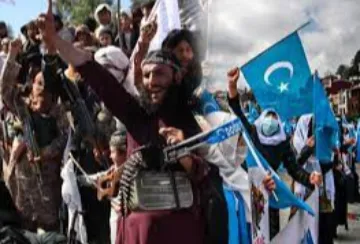
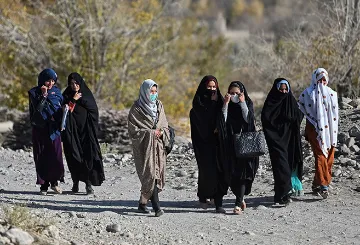
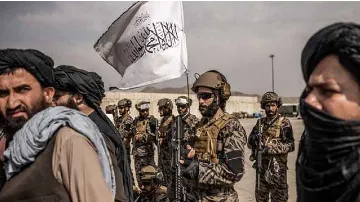
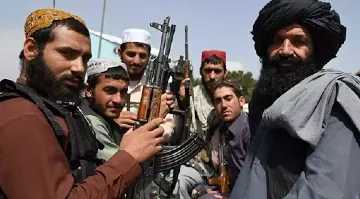
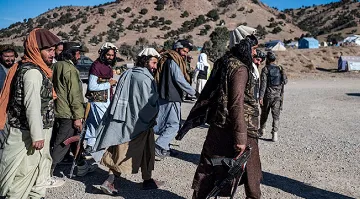
India's potential engagement with Taliban officials marks a significant policy shift amid geopolitical realities, raising concerns for national security.
Experts at the event opined that it is a win-win situation for India and Bangladesh to have a functional river, rail and road network.
This brief explores the work of the Bengali diplomat and academic Jayantanuja Bandyopadhyaya, whose book, The Making of Indian Foreign Policy (1970) is considered a classic in Indian scholarship in International Relations. It analyses Bandyopadhyaya’s distinctive contribution to IR theory, especially his attempt to craft a “hybrid” approach derived from Gandhi and Mao, on the one hand, and behavouralist systems theories, on the other. It
Sohini Bose, Ed., “Priorities for Prime Minister Hasina's New Term in Bangladesh,” ORF Special Report No. 225, May 2024, Observer Research Foundation.
The workforce participation rate of India’s women is significantly lower than that of the men; and amongst the women, the employment levels of urban women are lower than those of their rural counterparts. Using the findings of the 2018 Periodic Labour Force Survey (PLFS), released in 2019, this brief provides an overview of the current state of female labour force participation in urban India. It analyses data on vocational training and employm
The Pakistan Telecommunication Authority (PTA) placed itself in a highly embarrassing situation with its decision to ban the usage of 'obscene' words in text messages. Stiff resistance from users,
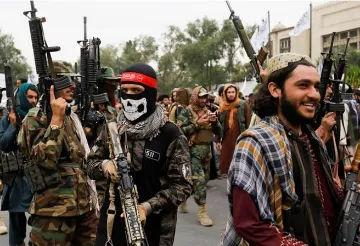
Efforts toward a peaceful reconciliation with the Taliban have failed and Afghanistan and the United States remain engaged in a bitter war against the insurgent group. The US has shown willingness and capability to go after Taliban leaders on Pakistani soil, upsetting its relations with Islamabad and ending Pakistan's game of plausible deniability. Under its new leader, Haibatullah Akhundzada, the Taliban continue their onslaught against the
The government has been successful in maintaining harmony with the military and preventing it from reacting violently in the aftermath of Bangladesh Rifle's mutiny.
The June 5 hartal, or shut down, brought back fears of the return of hartal politics which had been a bane of Bangladesh politics in the recent. Such shut downs often followed or preceded bouts of violence across the country, bringing the economy, and every thing else, to a grinding halt.

In many ways, Bangladesh seems an excellent place for al-Qaeda to find sanctuary in the decisive years ahead. It is an impoverished Islamic nation, politically weak and backward in its economic development. Its ports have been active hubs for transnational crime, including weapons running.
The removal of Prof. Muhammad Yunus from the Grameen Bank of Bangladesh has left a dent on the image of the Awami League Government of Prime Minister Sheikh Hasina, both at home and overseas.
In his writings in the closing decades of the 19th century, the novelist, nationalist and patriot, Bankim Chandra Chattopadhyaya placed the blame for India’s subjugation by foreign powers on what he called the “individualistic, other-worldly” philosophy of Sankhya, a philosophy based on reasoning, reckoning and enumeration.[1] This brief examines Chattopadhyaya’s charge and concludes that he was unaware of the power and this-wor
Recently, the Dhaka High Court declared Bangladesh as a secular nation. The verdict brought respite to the feeling of guilt among the people for denouncing secularism from the Constitution, one of the core values for which they had fought for during the liberation struggle of 1971.
Allegations against Hasina’s government include authoritarian governance, hounding of the opposition and rampant corruption. These issues and the India factor will dominate the electoral campaign.
The Shahbagh protests could become a defining moment in Bangladesh's history, bringing back secularism in to the midst of political debate in the country.
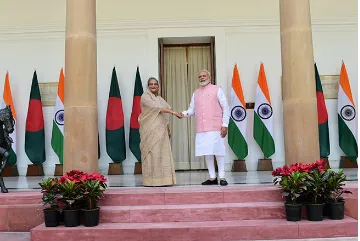
India-Bangladesh ties have entered an era of consolidation and expansion. Trade figures have gone up to $7 billion, though the adverse trade balance remains an issue.
By the standards of electoral practices in South Asia, incidents of violence in Bangladesh’s elections cannot be viewed as excessive. The allegations of malpractices cannot be dismissed outright since no election in Bangladesh has been free from these aberrations and violence.
India’s ties with Bangladesh have not been smooth and faced turbulence despite India supporting Bangladesh in its liberation.
Social marginalisation in urban India can be overcome by identifying committed non-State individuals/institutions, and supporting them so that they are able to successfully contribute to the government's reform process.
Urban inequality is a blight experienced by many cities, even in the developed world.In developing countries like India, these social and economic inequalities become even morepronounced, with living conditions in certain populations crossing the line to the abysmal. Inthese cities, agencies responsible for addressing welfare concerns are unable to do so, as theythemselves grapple with a host of challenges. This paper argues that any positive tra
Across India, existing systems for the collection, transportation and disposal of solid waste are mired in chaos. The problem is more acute in the urban areas, where rapidly growing populations generate increasingly larger quantities of solid waste that urban local bodies (ULBs) are unable to manage effectively. Improper management of solid waste poses risks to the environment and public health. This paper dissects the state of solid waste manage
A report by the Long War Journal has stated that the Taliban is now threatening five of Afghanistan's 34 provincial capitals.
Afghan National Army soldiers in Oruzgan province surrendered and gave up their military base to the Taliban and other South Asian roundups
Sri Lankans still hope to get jobs and incomes from Trinco development plans — it has not happened in the case of Hambantota.
Not many in Sri Lanka, particularly on the Government side, had expected China to play evasive on the report of the panel appointed by UN Secretary-General Ban Ki-moon on issues of accountability pertaining to the end-game of 'Eelam War IV'.
Sri Lanka’s pact with China for Hambanbota port may well be a case of strategic deception, and not just a political balancing act between India and China.
Storm strikes are common in the Indian Sundarbans Delta on the northern Bay of Bengal and will only become more frequent and intense in this era of climate change. Every time a cyclone has hit the Sundarbans, the attempt has been to adapt in situ by creating protective infrastructure, and later return to the same conditions prevailing prior to the disaster. Such reliance on the notion of ‘resilience’ has become increasingly unsustainable and
Street vending was illegal in urban India for almost six decades until the passage of the Street Vendors Act in 2014. Despite the law having legalised the activity, however, the default policy in most cities across India is to clamp down on street hawkers. Yet street vending remains a viable source of employment for many. As the pace of urbanisation increases across India, it is only likely that a greater number of street traders will contest for