-
CENTRES
Progammes & Centres
Location
18357 results found
Japan is now being pushed to a leadership role in Asia following the election of Donald Trump as US President
China's new maritime law – in which foreign vessels will have to submit details to Chinese authorities when transiting through its 'territorial waters' – has now come into force.
Most of the joint exercises being conducted by security forces, like like the Malabar 2015, are of the simple basic variety and, hence, really provide no 'net value addition' to the Indian force that participates. Thus, approvals for such exercises should necessitate a case-by-case approach in the future.
With the US and EU, who together are responsible for the makeup of 46% of the world economy, preparing to enter into the largest trade deal in history, the TTIP, the question of how the BRICS adapt and consolidate their position globally is one that holds considerable relevance. The options available to the BRICS are limited.
In 1990, China's GDP was roughly the same as India's and parts of its infrastructure, such as its railway system, were considered inferior. Today, China's GDP is around $9 trillion and India's is $2 trillion. The high speed train travelling at 300 kph from Shanghai to Beijing signals the extent to which China had pulled away from India.
Chinese belligerence further strengthens the motivation for Australia, India, Japan, and the United States to keep the Quad together.
During a discussion on "Urban Middle Classes and the Ascent of New Politics in India" at ORF, it was noted that success should not be measured in terms of the ability to ensure successful electoral outcomes but as an attempt to make better societies.
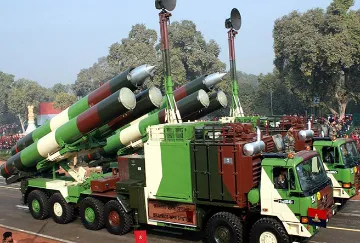
Developed by the Defence Research and Development Organisation (DRDO), the K-4 will be an intermediate range submarine launched ballistic missile (SLBM).
The Centre seems to be keen on development of Free Trade Agreements with our East Asian and South-East Asian neighbours. The general idea floated in this context is: Trade is good. More is better. But, unbridled market force in the form of unbridled trade without the concomitant safeguards in regulation and risk management mechanisms might not be a wise idea.
The Quad statement is tantamount to the declaration of the New Cold War between the US and its allies and China.
India’s geographical landscape is vast, cultural differences can be sharp, and income disparities are stark in certain regions. Access to healthcare, therefore, is varied and the on-ground gaps and challenges are complex. The NITI Aayog Health Index is an attempt by the current government to formulate a mechanism to monitor at the sub-national level the country’s performance in improving healthcare. This paper uses the findings of the Health
Before the elections in the beginning of this year, the authorities of the Iraqi Government had announced warrants for the arrest of 29 Iraqis and foreigners, who, according to them, are either former members of the Saddam Hussein Government or part of the Abu Mus¿ab al-Zarqawi terrorist network of the Al Qaeda.

Welcome to Naya Pakistan – just like the Purana Pakistan.
It has an opportunity, with the expansion of G7, to be a part of both the global south and global west
New Delhi must be hopeful that this successful visit will undo the damage done by the “unofficial blockade” of 2016.
It might be interesting to analyse our diplomatic handling of China and Pakistan on a comparative basis. These two countries pose the most difficult and complex foreign policy challenges to us. Is our approach to both countries similar, or there are differences in the way we engage them?
Despite the power differential, India successfully raised the cost of China’s land grab activities at Doklam, a feat that even the U.S. has struggled to accomplish in East Asia. While China was relentless in the pursuit of its goals, and had the resources to spend, India managed to call its bluff, and simultaneously allayed Bhutan’s concerns.
Chandrayaan-2, India's indigenous moon mission will set off for space, India's next mission will surely be to send humans to moon.
As China and the US pursue development of unmanned underwater drones, the Indian navy is also adjusting its strategy to include autonomous vehicles in its armoury against China’s growing undersea footprint in the Indian Ocean
The digital cooperation between India and Africa underscores a broader commitment to inclusive development, mutual capacity-building, and technological independence. Can joint digital innovation also drive socio-economic progress across the Global South?
The global pandemic has hit amid the 70th anniversary mark for relations and affected perceptions and realities in ties.

Use of weaponized drones, do-it-yourself armoured vehicles and a well-planned internet strategy have given Islamic State an unprecedented edge
The behind-the-scenes drama had all the ingredients of a potboiler.
A World Bank report on 'State of Social Safety Nets' paints an overall positive picture, with over one billion people worldwide being included under at least one safety net initiative. But the reality is that more than two-thirds of the world's 1.2 billion poorest are not covered.
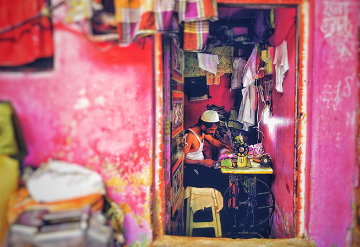
Find out all about water trading and how it can help solve the issues of efficient distribution and sustainability.
While New Delhi continues to walk a fine balance, its ability to sustain this approach remains to be seen.
Charlie Kirk’s visits to Seoul and Tokyo just before his killing shone a spotlight on the growing relations between movements on both sides of the Pacific
150 innocent lives have been lost in the serial blasts set-off by terrorists in Mumbai on July 11, 2006; the death toll is likely to mount. The blasts, sadly, are a chilling reminder that terrorist can strike with impunity and at will, secure in the comfort that they cannot be touched. If the 1993 Bomb blasts in Mumbai had a fig leaf of an excuse (the demolition of the Babri mosque), the current blasts have none.
Terrorists have taken to the use of social media networks in a big way. This brings us back to the old dilemma of how much data is information and how much information is adequate intelligence. The other dilemma is how much surveillance is enough for security. The third dilemma is how much liberty is to be sacrificed for security.
The quest for media management in an environment of a media so controlled is a quest for the impossible.
In the US, the party primaries to elect the candidates for the November election have begun. It is clear from the primaries that the Republican party is seeking to return to the middle ground from the excesses of the past when it was held hostage by the right-wing Tea Party.
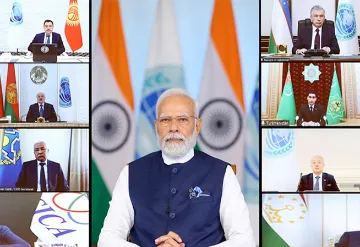
Disrupting conventional thinking, Prime Minister Modi held a video conference to fight Covid-19 with all SAARC leaders.
Narendra Modi's visits out of New Delhi last week have emphasised the new government's understanding of India's Grand Strategy. In some ways, it marks a continuity with the policy of past governments, but in important ways it presages a departure.
The US Navy has already developed a generic "Road Map" against climate change while we are yet to assess the impact of such changes, let alone formulate doctrinal responses. Let us not get caught napping.
How radicalised is Pakistan Army today? was the question which formed the focal point of an intense discussion organised by Observer Research Foundation on September 20. Well-known academics, journalists, experts and military officers attended the discussion which was chaired by Mr Vikram Sood, Vice President (International Affairs), ORF and former chief of Research & Analysis Wing.
At a meeting organised by ORF several experts said the current discourse on the Maoist challenge has been dominated by a "paranoid" view
When the Communist Party of Nepal - United Marxist Leninist (CPN-UML) Chairman Jhala Nath Khanal was finally elected as the new Prime Minister of Nepal, the country breathed a sigh of relief.
It's time policy mandarins remove their blinkers and jettison their vested interests to learn the sharp and focused lessons that history of science teaches so beautifully
While the Arabs tend to blame the West for their troubles with some reason, much of the blame they have to shoulder themselves. The Arab world is in turmoil mainly because of undemocratic regimes, lack of institutions, the absence of a spirit of scientific enquiry and societies that have yet to adjust to the 21st century.
Rather than having an ambition of $5 trillion economy that seems almost unattainable by 2024, it is now important that the next three years focus on the creation of better provisions of public goods and services like health.
Call for public discussions over how certain types of behavior associated with dominance and power create inequalities within and between man and woman
India's thinking about the Middle East, whether from the UPA or NDA, has tended to be ideological and rooted in their domestic political considerations. Prime Minister Narendra Modi needs to break from this tradition and develop a strategy towards the Middle East that is firmly anchored in realpolitik.
Prime Minister Narendra Modi has been energetically pushing the Indian view. If he is able to transform the Indian economy and put it on a fast growth track in the coming years, he will sharply enhance India's weight in the international system.
If the purpose of privacy is to preserve democracy, then data protection laws must reflect this purpose.