-
CENTRES
Progammes & Centres
Location
18372 results found
This article explores the role played by General-Purpose Technologies (GPTs) on the ebbs and flows of countries’ heft throughout history. From the printing press to artificial intelligence (AI), countries that embraced and innovated on these technologies have gained economic, military, and geopolitical advantage in various forms. Today, AI stands as the defining GPT of the current era, presenting both unprecedented opportunities and massive cha
Inaugurating the ORF conference on "Generating responses to an uncertain monsoon", Minister of State for Agriculture Harish Rawat emphasised the need to understand the science behind the behaviour of the monsoon for achieving a long-term drought-proofing solution.
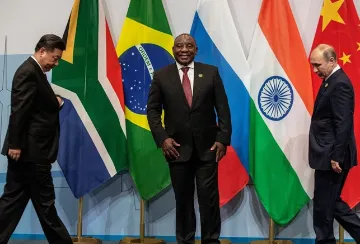
As the partner that stands to benefit the most from any expanded BRICS play, China needs to be singularly more magnanimous and mindful in accommodating the legitimate interests and aspirations of other member states.
In 1990, after the end of the Cold War and the unification of Germany, the United States of America gave an assurance to the Soviet Union that the North Atlantic Treaty Organization would not expand its role beyond the borders of Germany.
Can China slow down without imploding? No, says Mr. Osamu Tanaka, the Executive Vice President of the Policy Research Institute of the Ministry of Finance, Japan. He predicts that 2017/8 will be the beginning of a Chinese financial meltdown.
Although neither India nor China envisions participating in decisive naval battles given the interdependent nature of the world order, naval suasion continues in the Indian Ocean. The underlying strength for control of the Indian Ocean, however, is not geopolitical but economic power.
The geo-strategic uncertainties that prevail in Asia will drive India and Japan increasingly in the direction of jointly addressing the need for maintaining the prevailing balance of power in the continent, according to scholars from India and Japan.
The permission for Air India to fly over Saudi Arabia must be seen as a major breakthrough, cutting hours off flights between India and Israel
Pakistan's present actions of ratcheting up tensions not only on the Line of Control but also along the International Border, while obviously making an attempt to regain the initiative, is actually unlikely to pay any dividend for a number of reasons.
An autonomous Judicial Commission can effectively nudge the judicial system towards its intended Constitutional mandate; apolitical, enlightened and efficient application of the rule of law and protection of the fundamental rights of private entities, against encroachment by the executive or the legislature.
India must come to terms with the fact that what it does with one country is bound to affect its relations with others, notwithstanding the declarations to the contrary. For international relations is not a series of discrete bilateral relations. The answer lies not in circumscribing one's own options but in intensifying engagement with all.
The recent terrorist attacks in China's Xinjiang and the involvement of terrorist camps operating in Waziristan and nearby areas have raised serious questions about Pakistan's commitment to battle terrorist groups.
Prime Minister Narendra Modi and Chinese President Xi Jinping have just made back to back visits to the United States. In keeping with the times, both began their tours from that Mecca of our age - Silicon Valley.
The Chinese objectives are in perfect congruence with those of Pakistan in Afghanistan. Pakistan is also mindful of the fact that an enhanced Chinese presence will keep India away (at least Pakistan is hopeful of), thereby ensuring Pakistan the strategic depth that it has been seeking to achieve in Afghanistan.
Prime Minister Yousuf Reza Gillani lost a sliver of a chance in Pakistan's supreme legislative body National Assembly (on May 9) to steer his embattled country away from the perpetual dilemma of being stuck at the crossroads of destiny.
The panacea for the current problems emanating from a one-sided media coverages is public service media, insulated as much from the government as the market, something the Prime Minister promised during his earlier term - UPA-I.
Peaceful relations with Pakistan is a prerequisite to India’s domestic stability and its quest for great power status.
At the current rate of around thirty-four billion tons of CO2 emissions per year, we could exhaust our carbon budget in less than a decade
Those who want us to join the Western bandwagon and condemn Russia seem oblivious to their own stand when it comes to supporting India against China and Pakistan.
The United States (US) is the current world leader in the race to develop the most powerful advances and applications of Artificial Intelligence (AI), but China has steadily caught up in recent years. The launch in January 2025 of DeepSeek-R1, a powerful AI (reasoning) model developed and offered by a Chinese startup under open-source technology norms at a fraction of the current market costs, is being considered a milestone moment in this race.
Emissions from fossil fuel-powered motor vehicles adversely affect air quality and contribute to global warming. The manufacture and use of electric vehicles (EVs) is among the ways by which this challenge can be mitigated. This brief evaluates the best practices adopted by countries in the forefront of EV adoption, and outlines the lessons India can draw from them to inform its own EVs strategy. It finds that in addition to strengthening
Terrorism is not a new phenomenon. It is the calculated, targeted and indiscriminate use of intimidatory violence to achieve an objective, which could be political, economic, social or religious or to give vent to anger arising from political, economic, social or religious reasons. A terrorist gives vent to anger on behalf of a group or a community.
The IMF estimates that State-Owned Enterprise (SOE) assets totalled US$45 trillion in 2018, close to 50% of the global GDP, and calculated the debt of the largest SOEs to be US$7.4 trillion. Clearly, SOEs have a direct bearing on the global economy. The most systemically important SOEs are the State-Owned Multinational Enterprises (SOMNEs) since they are focused on cross-border financing and business. A global framework for regula
Global health diplomacy, once a cornerstone of soft power and international cooperation, stands at a crossroads. Recent upheavals – such as the US retreat from the World Health Organization – are challenging its role. Amid geopolitical tensions and biological threats, Lakshmy Ramakrishnan explores why global health diplomacy remains indispensable, and how rising powers like China and India can reshape the landscape
In the aftermath of the COVID-19 pandemic, reforming the global health governance system has become a key area of concern for the G20 and other multilateral platforms. This comes at a time when the world has increasingly become volatile, uncertain, complex, and ambiguous. As a grouping of developed and developing countries, the G20 must prioritise addressing global health challenges by identifying its direct and indirect determinants. This brief
What should be India's approach towards the international internet governance discourse? This Issue Brief attempts answer this question by examining the Indian government's engagement with the global community, using the recently concluded NETmundial conference on internet governance as a case study. It also provides policy recommendations for the way forward.
PM Narendra Modi's interest in the diaspora is about recognising India's possibilities as a "global nation" that is not defined in narrow territorial terms. Delhi, of course, is not yet ready to give dual citizenship of the kind that some countries do. But short of political rights for the diaspora, Modi has begun to offer much.
West Bengal Governor and former National Security Advisor M.K. Narayanan recently noted that contrary to what many security and strategic analysts in the West profess, terrorism remains by all means a grave threat to the civilised world. The reality is global terrorism is expanding, especially in Asia.
In the early years of the 21st Century, we find ourselves relearning the most enduring lesson of history. That is, ¿Only thing constant in nature is change. It is not the reality that is changing but change, which is becoming a reality.¿ The difference now is that the revolution in technology is making changes, including global trends and strategic changes, faster than ever before.
Growing urbanisation and its resultant problems and issues have drawn the attention of international organisations, national governments and the civil society. The United Nations (2012) has reported that while "unprecedented increase in urban population will provide new opportunities to improve education and public services in Africa and Asia,...
Eminent economist Professor Jagdish Bhagwati has defended globalisation staunchly in his latest book "In defence of globalisation" and so has the editor of Financial Times (London) Martin Wolf in his book "Why Globalisation works".
The recent violent actions of the Maoists have made big news. It will not be easy to resolve this problem because these are the people who have been deprived of their land and development, and they form the core of the movement. Only better distribution of the growth story can bring peace to these people
India lacks resources and direct access to Afghanistan, but it can derive some comfort from the fact that, if the past is any guide, you can always trust Islamabad to give us the opening through its propensity to overreach.
The US constitution builds a wall of separation between the church and the state, interpreted as prohibiting the state from meddling into the affairs of the church and vice versa. However, this constitutional provision cannot negate the church's influence in impacting who gets elected as President.
The All Party Hurriyat Conference¿s rather studied acceptance of the Centre¿s offer of talks while welcome should also add to the seriousness of the peace process in Jammu and Kashmir. While distancing Pakistan from a process that had been trilateral in the past formulations of the Hurriyat, the current round would expect the Centre to go beyond traditional pulse-feeling, and gestures.
The Indian proposal for a SAARC power-grid, revived by Union Minister Piyush Goyal, has the potential to increase power-generation in South Asia. It also has the potential to reverse the way the South Asia thinks about itself - and the world thinks about South Asia, besides cutting oil bills of countries like India.
The Power sector reforms in the country have presented the next strategic challenge that could redefine global interest in India. The country has set an ambitious target of producing 20,000 MW of Nuclear power by 2020 i.e. around 1000 MW of additional nuclear capacity per year for the next 17 years.
In the current and preceding years, the government has been trying everything to limit gold imports to control the current account deficit. Yet this commodity has one of the largest share in terms of exemption given. In 2012-13, the estimated amount of custom duty foregone for diamond and gold would be Rs 61,035 crore or 20.5% of the total revenue foregone.
The New Telecom Policy if implemented in letter and spirit has the potential to fundamentally transform governance.
Pakistan's first transfer of power between elected governments is indeed a milestone, but how strong a precedent it will set is very much dependent on the performance of Nawaz Sharif and the PML-N. Confidence in civilian institutions, high voter turnout aside, remains dreadfully low.
Radical transformation in governance can only begin when we are pushed to the wall and have no other option but to take the monster head on