-
CENTRES
Progammes & Centres
Location
18346 results found
At a conference on "Civil Society and Nuclear Weapons Policy", organised by ORF and Chatham House in Bangkok, there was a general consensus among participants that the emphasis should be given on raising awareness on the various hazardous impacts of the nuclear weapons explosion, especially in the nuclear weapons states.
Beginning March 26, 2015, a Saudi Arabia-led coalition of countries, comprising nine other Arab countries, backed by the USA, France and UK, launched air strikes in Yemen against the Houthis and army units loyal to former Yemeni President Ali Abdullah Saleh.
Nepal's Chief Justice Khil Raj Regmi has been appointed the Head of the interim government. His main mandate is to hold elections for the CA. But 22 opposition political parties have begun their protest programmes against the new government, raising doubts whether polls can be held in June this year.
In the CJ impeachment case in Sri Lanka, the options for the Government are fewer, while for the Chief Justice, it is still worse - when it comes to enforcing Parliament's will on the one hand and the judiciary's decisions on the other.
Cost and time over-runs have reportedly led to losses of approximately Rs29,000 crore in the DRDO; some 10 projects have been delayed for over five years. The Armed Forces continue to be woefully short of modern weapon systems, ammunition and a vast range of critical equipment.
Even today, renewable energy sources definitely cannot replace fossil fuel that is getting scarce over time. Given this theoretical underpinning, why do we have a negative price for crude oil?
Climate change has added to the enormity of India’s food security challenges. While the relationship between climate change and food security is complex, most studies focus on one dimension of food security, i.e., food availability. This paper provides an overview of the impact of climate change on India’s food security, keeping in mind three dimensions — availability, access, and absorption. It finds that ensuring food security in the face
The relative prosperity being recorded by the countries of the Bay of Bengal Initiative for Multi-Sectoral Technical and Economic Cooperation (BIMSTEC)[1] is being confronted by multidimensional challenges brought about by climate change, including in public health. This brief examines the role of regional cooperation in mitigating these negative consequences of global warming. Analysing the national health policies of BIMSTEC countries, this bri
The climate narrative is beginning to exert itself in the development processes of poor countries. The impact of climate negotiations, and green capitalism that is rearing its head, are some elements that will define climate and security for India and other developing countries.
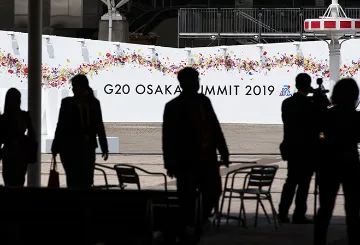
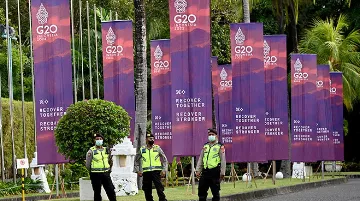
The alchemists of capitalism have turned the sparse carbon into 'carbon real estate,' available for sale to the highest bidder. The weak and poor have been priced out. And at the G20, we have just offered to subsidise the rich to buy more.
India’s critical water infrastructure must be built to withstand, respond to, and recover rapidly from climate disruptions
In 2015, the Paris Agreement of UNFCCC emphasised the role of climate finance in strengthening the global response to climate change. Since then, developed countries have made various claims about climate finance flows. Some of the myths surrounding climate finance need to be demolished.
Climate is a global common, and the task of reversing the worsening climate change is a global responsibility. There are two aspects to climate action: adaptation and mitigation. This paper focuses on mitigation, the global efforts for which are uneven as some countries are performing better than others. The paper evaluates the mitigation efforts of the G20 countries, which are collectively responsible for some 80 percent of global greenhouse gas
The time has come for rapidly growing Asia to distinguish between the global, regional and national aspects of climate policy, recognise the linkages and shape the deliberations for the new climate regime by taking substantive measures at home.
Food self-sufficiency has been India’s greatest achievement, which must be celebrated. But India urgently needs to wake up to the significant challenges that climate change poses to its long-term food security and adopt urgent measures
Clinton's visit to southern India clearly underscores the increasing clout the region has, both economically and politically. No longer is there a sense that foreign policy is framed exclusively through a north Indian way of thinking. And Clinton discussed Sri Lanka with the Chief Minister of Tamil Nadu.
There is a periodic urge in the West to fix Iran. Syria and Iran had been listed on the State Sponsors of Terrorism list for decades even before September 11, 2001. In 2002, George Bush described Iran as a member of the 'Axis of Evil'. Despite all this, there were talks of negotiations.
Delhi CM Arvind Kejriwal should take a leaf from the Republic Day chief guest, Japanese PM Shinzo Abe, and profer the much-awaited #AAPnomics of job creation, a strategy on wealth distribution, and, a vision on efficiency. His genius will lie in these making sense to the poorest and the weakest - without forgetting global investors and our diaspora.
As the world comes closer in the wake of information explosion and gobalisation, the idea of ¿Cooperative Federalism¿, which is seen as a tool to resolve conflicts, is gaining increasing relevance and acceptance. Inspired by this development, a two-day International Conference on ¿Co-operative Federalism and Management of Diversity¿, has been organized from November 2-3, 2004, under the auspices of Observer research Foundation (ORF) , New Del
Governance of the energy sector in general and the coal sector in particular has to radically change if India wants to take advantage of its vast coal resources. It must be understood that coal is the only fuel that India has in abundance and it must be exploited to the fullest.
Coal companies can achieve a great deal if they strategise action plans to improve mine productivity, capital equipment utilisation, mine recovery ratio etc., to international standards. There is also urgent need for introducing more advanced technologies and modern management systems.
As the two codes of conduct on space - European Union's (EU) Code of Conduct (COC) on Space and the Stimson Code - are gaining momentum in the international arena, Observer Research Foundation (ORF) organised a roundtable on Thursday, May 26, 2011 to discuss India's concerns with these codes.
Evolving, stealthier submarines are driving maritime nations to invest in strategic uncrewed anti-submarine warfare (ASW) technologies. Advancements in sensor technology, digitalisation, data analytics, and machine learning—leveraging inputs from multiple uncrewed autonomous systems—are enabling AI-powered digital twins. Based on data from land, sea, air, space, and cyber systems, these twins can support a Centralised Command, Control, and In
With Gaddafi around, there will be no peace in the Arab region. Africa will also be badly affected. That is why Gaddafi's Foreign and Interior Ministers and several Libyan Ambassadors deserted him. What high moral dictate or compelling necessity led to India's neutral stance in the vote on Security Council Resolution 1973?
Military capabilities remain the sine qua non of international politics. Therefore, critical defence reforms in India will have to be pushed with greater vigour. Without institutional, doctrinal and procedural changes, New Delhi will not be able to make the most of this moment in global geopolitics
The challenge for India is much larger than voting choices on the international resolutions on Syria. It is about finding effective ways to cope with the expanding Saudi-Iran rivalry, which is not limited to Syria.
Civil wars are drawn-out conflicts, often lasting up to a decade or even longer before a political settlement is reached. Pakistan's military campaign against Pashtun militants, variously allied to the Afghan Taliban, the al-Qaeda, and often fighting for localised interests has stretched into its 12th year.
The problems of water, energy, climate change, and urbanisation, are all intertwined; they are, also, all 'wicked'. There is little consensus on how to effectively navigate these problems, let alone, how to solve them. Of these, water is key: the threat of climatic changes is primarily manifested in water, its dwindling supply, and the conflicts that may potentially arise. It also encompasses so-called 'toad's eye' concerns of the grassroots, oft
Even before 9/11, many commissions had been appointed by different Governments to study the threat posed by terrorism and many seminars, conferences and workshops organised by different think-tanks on the subject. In the US alone, there were three high-powered commissions on the threat posed by terrorism. All this could not prevent 9/11.
A two-day deliberations by 20 experts from India, China and U.K, have underlined the need for a collective regional action to ensure environmental security in South Asia. The meeting was organised by Observer Research Foundation in collaboration with Royal United Services Institute, London and Chinese Academy of Social Sciences, Beijing.
Address by Colombian Deputy Foreign Minister, at the Observer Research Foundation, New Delhi, on November 3, 2011 on Colombia's Agenda for Domestic Prosperity.
The UPA's policy failures on Bangladesh and Sri Lanka have generated much bemoaning in Delhi's national security establishment about the breakdown of the rules of the republic that made the conduct of foreign policy the sole responsibility of the Centre. A closer look reveals that it is not the states that are exercising a veto over foreign policy decisions.
Renewed proximity with India can help Sri Lanka reduce its dependence on foreign reserves, while giving Delhi the leverage to push for benefits
My revered teacher late professor Matin Zuberi had once remarked that major states in global affairs, real or aspiring, end up possessing superfluous arsenals often times through superficially planned and mostly ad hoc manners.
The COVID-19 pandemic pushed most economies into recession and heightened inequalities within and across countries. Mitigating current challenges requires greater solidarity, innovative thinking, and more effective international development cooperation. This paper makes a case for triangular cooperation as an instrument of development cooperation in current times. It outlines its advantages, examines the challenges involved in such partnerships,
The year 2015 marks an important date in international history - the 70th anniversary of the end of World War II. It is also the 50th anniversary of normalisation of relations between South Korea and Japan. And, it is a chance that both Japan and South Korea should grab with an aim to re-normalise their relations.
The United States and Luxembourg have adopted domestic space laws granting certain legal rights to space mining companies. These moves have initiated a debate on the future of this industry, as well as the passing of relevant laws governing outer space and its resources. This paper makes an assessment of commercial space mining activities in the broader context of the emerging space economy. It finds that entrepreneurs are increasingly looking at
It is commonly recognised in Jerusalem, and elsewhere that the Likud PM, Mr. Benjamin Netaniyahu, nurses an adversarial chemistry with the US President. He went ahead with Jewish settlements in a most insulting reception to US Vice President, Joe Biden.
The Bay of Bengal Initiative for Multi-Sectoral Technical and Economic Cooperation (BIMSTEC) appears to be gaining momentum in formulating collective strategies to combat non-traditional security threats in the subregion. This brief describes how BIMSTEC had focused on bilateralism or trilateralism from its inception in 1997 until 2015, thereby failing to pursue a more comprehensive and long-term approach to addressing the common threats to their
Utilising connections and collective action to accelerate social advantages, increasing youth inclusion and gender balance are crucial.
This paper highlights the increasing importance of Community Driven Development (CDD) in the delivery of public services to the poorest sections and enhancing access, voice and accountability in developing countries. Community participation in the delivery of ‘public services’ to the poorest sections of the population in developing countries has often been regarded as an effective mechanism to enhance access, voice and accountability.