-
CENTRES
Progammes & Centres
Location
15597 results found
The expected meeting has seen a focus on what both sides could agree to on the defense side.
India had several reasons to seek a quick stabilization and reaffirmation of its relationship with the UAE.
The diversity of engagements planned during PM’s visit suggests that after a long hiatus, relations between two of the world’s oldest civilizations are on an upswing
Canberra and New Delhi look at each other as vital partners playing critical roles in maintaining peace and stability in the Indo-Pacific.
Development partnerships between countries are crucial in addressing policy challenges in the developing world. Cooperation between countries in the Global South, in particular—such as those that India engages in, under its Development Partnership Administration (DPA)—is heightening conversations around the demands of sustainability. Yet, India continues to lack an appropriate framework by which to assess its development partnerships

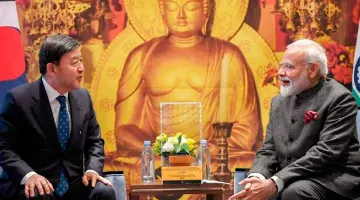
President Moon’s visit came at a time when both countries are well poised to expand their security and economic engagements.
PM Modi's 'Make in India' is a grand idea to reboot the ailing manufacturing sector. But the success of this programme will largely depend on creating an enabling ecosystem for manufacturing. This would require serious reforms in taxation.
While India was part of the Moscow Format talks, it’s also a member of the new Middle East Quad.
As India reconfigures its China policy with the Indo-Pacific at its core, India-Russia ties won’t be able to escape this strategic reality
The India-Japan partnership has matured into an important component of the new security and economic architecture of the Indo-Pacific region. For a long time, the partnership was centered on economic matters. But it has diversified to cover a wide spectrum of interests including security, counter terrorism, sea-lanes, UN reforms, energy security and climate change.
The share of women’s cooperatives in India is just about 2.5 percent and more than half of those are dormant. Can 2025, the International Year of Cooperatives, provide the impetus for transformation?
The Indian parliamentary delegation's visit to Sri Lanka was not expected to fast-track a solution to the ethnic issue. Yet, it has facilitated continued Indian engagement on the subject with various stake-holders, the Government, the TNA and the UNP Opposition.
Sheikh Mujibur Rahman is popularly known as Bangabandhu or Friend of Bengal. He became the Prime Minister of Bangladesh in 1972. He was a close friend of Prime Minister Indira Gandhi.
New security challenges confront India today. Newer areas of conflict and contestation are emerging on the horizon. These challenges call for dynamic and autonomous response mechanisms.
BRICS and SCO are two key non-Western multilateral platforms where India and Russia cooperate closely. In the past decade, both these countries have seen shifts in their foreign policies, which has also impacted their approach towards multilateralism. At the same time, BRICS and SCO have also seen their initial agendas widen to include a greater engagement with regional and global issues, including the creation of a multipolar world order. Along
Municipal governance has once again taken centre stage in Indian polity. There is a current re-shaping of narratives within the national government to make local governance effective. It is realised that deficit in the delivery of urban services results in chaos, which forms the basis for citizens doubting the functioning of the local government.
The form of engagement between India and Africa should be defined by the idea of long-term mutual benefit and sustenance, and not merely by development and aid-giving.
As immediate neighbours, India and Myanmar have little choice but to engage each other closely. Such engagement needs understanding of each other's social and economic interests, and respect for each other's political and strategic concerns.
A delegation of Myanmar civil rights groups was of the view that civil society groups could be used as a catalyst for social change in their country. They hoped that the civil society would be able to play a critical role in further transforming the seemingly changing political system of the country.
The opening of Myanmar, which till recently was considered a black hole, has unfolded a new situation, with that country becoming an important bridge for India looking northwards, eastwards and into the Bay of Bengal region.
A question that merits a sharper assessment is the impact of Myanmar's transition process on India-Myanmar relations. Security cooperation between the two countries since Myanmar's transition has definitely scaled up. The most visible demonstration is Indian Army's recent cross-border operation.
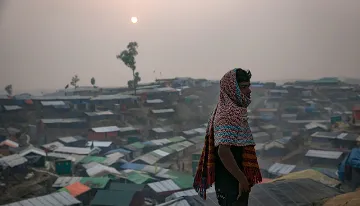
Bangladesh has seen massive demonstrations in favour of the Rohingya refugees, particularly from Islamist parties and organisations whose sympathy is driven by religious affiliation.
Myanmar has become a preferred investment and trade destination as the South-East Asian country has been able to generate great interest from businesses and nations worldwide.
Myanmar's top military general, Than Shwe, would use his India visit to convey the message to New Delhi that his country's relationship with India remains strong and undiluted in the backdrop of the recent events.
Nobel Peace laureate and pro-democratic champion of Myanmar, Daw Aung San Suu Kyi is expected to visit India in mid November. The dates are yet to be finalised. This would be Suu Kyi's first visit to India since her political carrier took a downward turn after the elections of 1990.
Myanmar's bilateral engagement with India in trade has gained momentum since 2008 when political and economic reforms were launched in the former 'pariah' state. India-Myanmar trade has more than doubled in the last seven years and has crossed $2 billion in 2013-14,
There appears to be a near perfect alignment of the stars for the Indian and U.S. space agencies to collaborate under.
Only a small trickle of INDCs has been submitted by other countries. So there isn't much by way of international examples for India to consider. The EU has said it will reduce its carbon emissions by 40% by 2030. Mexico has submitted both conditional and unconditional INDCs.
To sequence Indian priorities on the FDI question is fairly simple. Consumer-centrism is paramount. Competitive SME sector growth, which will lead to job creation as well as value addition, is a strategic economic priority, which in turn can be aided by a strong e-commerce industry as has been witnessed in China.
As India's water availability declines, a holistic approach to water pricing will be needed to avoid conflicts
One of the collaterals of the 2G verdict of the Supreme Court, which saw the revocation of 21 of Sistema Shyam Telecom?s 22 licenses, could be the flickering and faint Russian Interest in Indian business opportunity.
Nawaz Sharif's return as the Prime Minister of Pakistan in early June this year marks a signpost from where a more meaningful relationship between India and Pakistan could be forged. The bilateral relationship had of late been mired in mistrust and often meaningless rhetoric. The previous civilian government in Pakistan was paralysed by its own ineptitude. An equally incoherent position in New Delhi has allowed the crucial relationship to drift.
In a fast-changing world, it is incumbent on the leaders of India and Nepal to start a new era of understanding and cooperation that take cognisance of the changing dynamics of economic and power relations in the region.