-
CENTRES
Progammes & Centres
Location
15606 results found
The global order is fast-changing; the field of International Relations (IR), less so. Despite the rise of other countries in economic and geopolitical terms, the field of IR continues to be dominated by the West and its theories, methods and policy concerns. The idea of ‘Global IR’ proposed in this brief aims to make the field more inclusive and universal. After outlining the major elements of a Global IR paradigm, the brief suggests that In
Modi has a rare opportunity to tap into the positive trends within the South Asian diaspora. An intensive engagement with them would be a valuable complement to Modi's declared strategy of befriending neighbours. Modi could signal the new approach by meeting their representatives during his Australia visit this month.
Conventional investments cater to investors who intend to gain financial returns. Other investors whose aim is to generate a positive social or environmental impact at a decent rate of return, turn to “impact investments” for their purpose. Mobilised to finance social enterprises, impact investments assume three primary forms: embedded, integrated, and external. This paper discusses the ideas of impact investment and social enterprises, and o
Withdrawal of the GSP will hamper India’s export growth to the US.
ndia is attempting to introduce a streamlined tax system to handle indirect taxation within the country. While the new system has been acknowledged as beneficial in a number of ways, there remain concerns regarding its implementation. If handled poorly, this tax reform could have long-term effects on the Indian economy.
In the 21st century global and regional contexts, it's too much for India and its southern neighbours to expect the US to stay away from the region, militarily. If the US is there, the assumption is that China will not be far away. India can make a difference to what could emerge as the re-emergence of a 'new cold war' in this region.
Both President Obama and Prime Minister Modi have seized the moment to reinvigourate the bilateral ties. If Modi has put America at the very centre of his dynamic foreign policy strategy, Obama appears eager to work with what is undoubtedly a more vigorous and action-oriented government in Delhi.

The financial health of the Indian Railways, the single largest employer in the Government of India, has been in a dismal state for some time now. With the recent merging of the railways budget with the general budget, it has become a daunting exercise to conduct an analysis of railway finances. Yet, it is no doubt in the national interest to not only locate the shortcomings in the system but also explore solutions to improve performance. This pa
Noting that the objective of the armed forces is not to win wars but to prevent wars, there was a consensus at an ORF discussion that India needs to overcome its deficiencies in order to create a credible deterrence.
The multiple crises besetting India’s justice delivery system are related to a large extent to what the Chief Justice calls “dilapidated” infrastructure. Indeed, it is empirically known that there is a positive correlation between adequacy of infrastructure—whether courtrooms, chambers, sanitation facilities, or digital connectivity—and productivity in the delivery of justice. This brief highlights the stark gaps in infrastructu
The treatment of mental health disorders is a difficult task due to the highly subjective nature of each case, the varying efficacy of drugs available, and the social stigma associated with mental illness. In India, the treatment gap is steep, but it can be reduced in a number of ways: through concerted efforts by the biotechnology and pharmaceutical industries on novel drug development; by leveraging allied technologies such as data science, art
This brief examines the status of research in Indian higher education and offers an overview of the concept of undergraduate (UG) research as a means of reform. The article attempts a brief review of the government efforts to improve higher education research, and underlines the limitations of their scope as well as their implications. Through an expansive review of existing empirical and qualitative studies, this brief shows the benefits and imp
There is no reason to believe that we will witness some change in Pakistan’s foreign policy.
India and China cannot afford to be used against each other by interested third parties. They must rather focus on common threats to regional progress. In a new world, India and China could be powerful allies, says a senior Chinese strategic scholar.
India’s aspirations of becoming a superpower must first begin with establishing itself as a strong regional power.
In bragging about the Indian Army post the surgical strikes by comparing with Israel Prime Minister has ignored the reality
Countries are relying on internal strength, engagement with Beijing and external balancing. Prioritise wisely
The measure of a successful energy transition must go beyond statistics of installed capacity of renewables, investments and number of jobs. While these are important, the face of the transition should become the lives, livelihoods and well-being of the economy
With the elections underway in India, eyes are now on the outcome of the polls, likely to be known by May 16. Wider belief is that the Bharatiya Janata Party-led National Democratic Alliance (NDA) may win the keenly fought elections.
The Bay of Bengal—home to a number of major ports that are lifelines for the economies and populations in India’s east coast that depend on them—is highly prone to extreme weather events. This brief examines the disaster-resilience of three of the ports on the Bay of Bengal: the ports of Kolkata in the state of West Bengal, Visakhapatnam in Andhra Pradesh, and Chennai in Tamil Nadu. The brief describes the destruction wrought on these ports
This paper highlights the imperatives for India’s G20 Presidency for promoting development cooperation towards the achievement of the Sustainable Development Goals (SDGs). Given its unique development cooperation model—more precisely, its development partnership model—India can utilise its G20 presidency to push the sustainability agenda. This will help bridge the North-South divide in sustainable development financing. The paper recommends
Both India and China seem to be fixated on a "status quo plus" option, in that each side wants something more than the current LAC. Clearly, much more work needs to be done. For the moment, incremental progress is better than no progress at all.
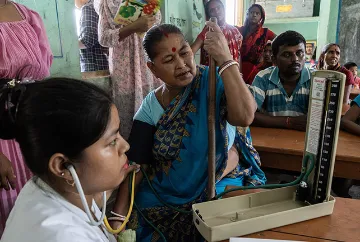
India-Israel ties are on course for further expansion under Narendra Modi and Benjamin Netanyahu, who have developed the personal chemistry needed to take it forward
Technology is vital to enabling accelerated socio-economic growth, effective governance, and relief delivery at scale. Many economies are adopting and developing technology-first frameworks to strengthen their population’s social welfare net, and support economic growth. The COVID-19 pandemic has exposed both the challenges and opportunities in India that can be addressed and driven by multidimensional technology frameworks. With the rebalancin
India must honour its treaty commitments over a resource that everyday lives depend on.
India and China have many similarities and the inequalities in incomes are clearly visible in China as in India, according to Mr. M.R. Sivaraman, former Revenue Secretary of the Government of India.
To reduce inequality of income, the government should increase taxes rather than reduce taxes.
Organ and tissue transplantation suffers from a large gap in supply and demand, with less than 10 percent of annual demand being met globally. In India, the problem is exacerbated by persistently anaemic organ donation rates, although the numbers have more than doubled—albeit, from a low base—since 2014, when the National Organ and Tissue Transplant Organisation (NOTTO) was set up. Until recently, analysis was hampered by the lack of comprehe

India is experiencing the fastest increase in prices among the big emerging market countries. The Reserve Bank raised interest rates 10 times since March 2010 to control inflation, and its adverse impact on the demand for goods and services, investment and corporate profits is already visible.
This brief probes the role of the current 116th US Congress in strengthening India-US relations in the realm of defence trade and technology transfers. The analysis is done in the context of the Trump administration’s relaxation of arms export policies, as well as a rise in conservative nationalism which abhors arming partner nations that prolong US conflicts overseas. Furthermore, as the Democrat-majority House of Representatives appropriates
Today's intelligence agencies operate in highly complex environments. Cold War definitions and understanding of threats have long become redundant. Threats are multiple, layered, networked, diffused and transcend social and spatial boundaries.
Under its International Terrorism Watch Project, the Observer Research Foundation (ORF) organised a one-day Workshop at New Delhi on October 20, 2004, on the theme: "Recent Intelligence Failures in the USA, the UK & Russia: Their Lessons for India".