7483 results found
The US is entering its trickiest phase in the Af-Pak region, where elections are due in both, Pakistan and Afghanistan just around the time Washington has set for its troops to depart. Can troops depart without an overt or covert understanding with Iran which has a long border with Afghanistan?
It can happen in the hurly-burly of politics that a flood of images abruptly wells up to the naked eye and demands attention so that we do not miss out on an entire slice of politics breaking away to get transmuted as current history.
As the foreign secretaries from India and Pakistan try this week to sustain the peace process amidst growing mutual suspicion, the Siachen question offers one potential area where recent progress could be consolidated. Discussions on the demilitarisation of the Siachen conflict zone have been proceeding slowly but surely towards a political agreement, even though the pace is too gradual to satisfy pragmatic analysts in both countries.
While there was no question of any rapprochement between Bangladesh and Pakistan, there are Muslim diehard elements in Bangladesh who draw their inspiration from Pakistan. These elements aim to strike at the very basic concept of Bangladesh.
During the meeting between the home secretaries of India and Bangladesh held in October this year, Bangladesh agreed to sign an extradition treaty and there has been major progress on this regard.
The first few weeks of Afghan President Ashraf Ghani's tenure has seen a flurry of diplomatic activity. The steps taken by him in the foreign policy domain give a clear indication of the new government's priorities.
The unspeakable tragedy of the floods in Pakistan, on a scale unknown to man, has dwarfed much else in the region: 100 shot dead in three days of political, ethnic and sectarian violence in Karachi,
Russia's response to new missile defence plans of the US points to Moscow's continued distrust of Washington. However, Moscow and Washington have announced a meeting to discuss the new missile deployment plans in Moscow in late May this year. Perhaps, a breakthrough is still possible.
India presents more immediate potential for the "top line" obsessed Silicon entrepreneur. But Asian companies from Japan, China, and Korea in sunset industries, are better placed to be responsive to the fragmented Indian market than a Fortune 500 corporate, which survive on scale not agility.
Russian President Vladimir Putin is scheduled to visit India in December 2025. The outcomes of the annual leaders’ summit will be largely determined by how India untangles the trade spat with the United States.
Pakistani President Pervez Musharraf's address to the nation on July 22 - as the people of London reeled from a second series of blasts at underground train stations - betrayed a sense of anxiety, a clear shift to address the Islamic community and an unwitting admission of failure in the war on terrorism.Wilson John
This critique on the Draft Report on Integrated Energy Policy was serialised in Volume II, Issue 43-46, 50 of ORF Energy News Monitor. It has three sections, first, Concept level issues- identifies the gaps in the Planning Commission's draft report, second, Action plan- for filling those gaps and lastly, Conclusions.
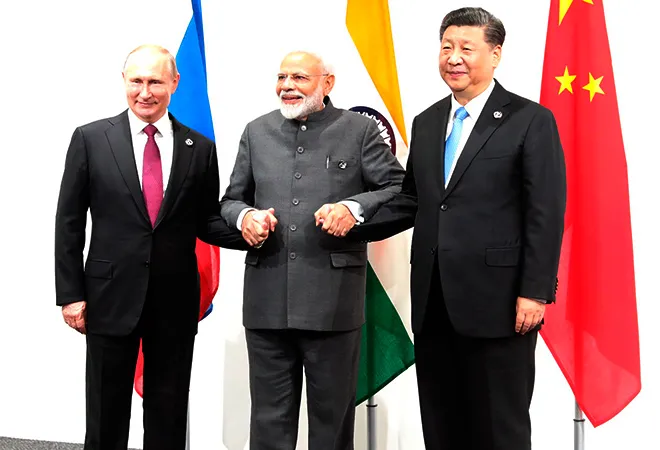
Together, Russia, India and China occupy around 50 percent of Asia's landmass. The three countries constitute some of the largest economies in Asia. There are a lot of potential synergies among the three countries, making a compelling case for their collaboration.
US commitment to Asia-Pacific security is evident in the ‘Aukus pact’ that will see it share nuclear technology with Australia
US President Barack Obama's latest strategy will seek to responsibly end the longest foreign war that the US has ever fought. At the same time, the strategy calls for building an enduring partnership with a sovereign Afghanistan. Obama's message to the Afghan people is a simple one: "as you stand up, you will not stand alone."
What is the measure of success for the Space Code of Conduct, or more substantially what is different about this Code effort that distinguishes it from the last? If the Code of Conduct fails to attract signatures of key players will its success be taken into question?
Iran is being treated more like North Korea, even though it is one of the world's great civilisations, with major historical and scientific achievements. And, as anyone who has deeply analysed the personalities of Ahmadinejad and Kim Jong Un knows, they don't look like one another. Or like one another.
For the first time in 30 years, Elections-2014 has thrown up a decisive Parliament. The Treasury Bench does not have to do number-crunching all the time, to push policy initiatives, legislative initiatives and even budgets - which have more often than not been passed in the midst of din and dust.
The speculation regarding General Ashfaq Parvez Kayani's possible extension came to an end last week. Prime Minister Yousaf Raza Gillani in a rather dramatic fashion announced a full term extension for General Kayani on national television.
The Interim Budget presented by Finance Minister P Chidambaram was a strange one. It contained much praise for the ruling coalition UPA's entire tenure, peppered with some disappointments.
Iranian civilisation is heresy-prone. Heresy is indicative of a questioning mind. Throughout history, individuals and movements have emerged in Iran to invoke the moral imperative and disrupt the status quo. The most recent events sustain this characteristic of the Iranian personality. Paradoxes abound in the vote in the June presidential election: it was anti-establishment, not anti-regime, anti-clerical but affirmative of the principles of the
America’s global hegemony is the sum total of its domination in various regions of the world like Europe, Middle East, or East Asia. Today when the Americans look at East Asia, they see a hugely enriched and militarily powerful China increasingly challenging them.
At a time when Rahul Gandhi and his team are wondering how to win friends and influence people, the Sufis offer an excellent model. For the model to gain traction, the first requirement is a message which can be simply put across.
Saudi Arabia recently extended an invitation to Iranian Foreign Minister, indicating towards a possible thaw in relations. Is this shift in Riyadh's stand because of a change in US-Iran relations and the positive reception of Iran's overtures by the other GCC States?
India must accept its own exceptionalism. It must thereafter understand how to establish it. India is in a position to shape cyberspace debates, but for that it will need to be flexible, propositional and present everywhere that internet governance is debated. Its strong and diverse contingent at The Hague is a good beginning.
India and Bangladesh, acting together, can drive South Asia’s economic and social progress
The Arms Trade Treaty being an instrument impacting many countries, it is important for it to come into being through consensus. A treaty without support from major exporting and importing countries would undermine its very purpose.
A lack of legitimacy of the new leadership in Kabul in the eyes of the Afghan public could pose potential problems for it at a time when it is confronted with a number of challenges. This could be exploited by the Taliban as well.
India, today, has the heft to influence the geopolitical dynamic around it. In pushing for improved relations with one, India's ability to enhance ties with the other two will significantly improve. Masterly inactivity, on the other hand, would surely make India lose ground with all the three.
Dr.A. Q. Khan, the self-styled father of Pakistan's atomic bomb, is back in the headlines following a statement disseminated by the National Council of Resistance of Iran, a group opposed to the present regime in Teheran, on November 17, 2004, that between 1994 and 1996 (Mrs.Benazir Bhutto was then in power) Dr. Khan gave Iran a Chinese-developed nuclear warhead design.
The Aam Aadmi Party's victory in 67 out of 70 Delhi Assembly seats has simply blown the established parties like the BJP and the Congress out of the water. It has inflicted by far the most crushing defeat to its opposition in independent India's electoral history.
There has clearly been a Modi effect in the assembly polls, but but whether or not there is a Modi wave in 2014 will depend on just how the BJP uses the momentum it has now gathered. And the stunning performance of AAP in Delhi signals the arrival of the urban discourse into national politics and the breakdown of identity politics of yore.
The trends emerging from Odisha and Chhattisgarh following the latest kidnappings of popular officials confirm to a certain global pattern - desperation leads to unpopular acts. These measures suggest they become considerably weaker and are making desperate attempts to wage easy propaganda.
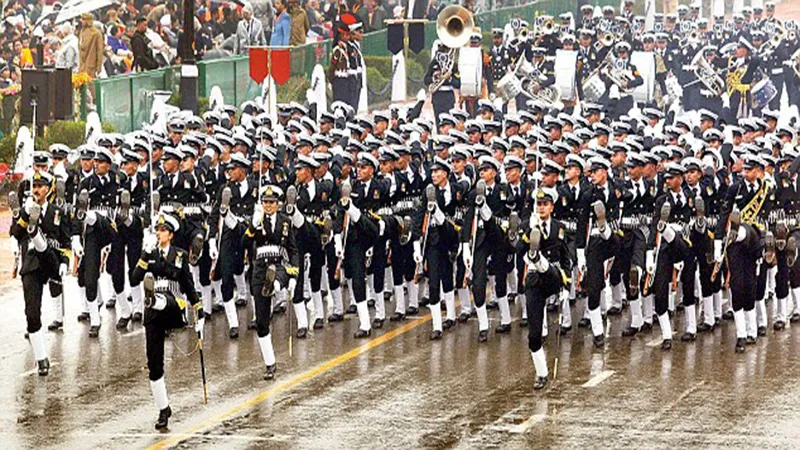
In inviting Japanese Prime Minister Shinzo Abe to be the chief guest of this year's Republic Day celebrations, Delhi has underlined the special importance it attaches to East Asia. Abe is the fourth East Asian leader to be part of the annual event in the last five years.
Japan's Prime Minister Shinzo Abe believes that his country needs quicker and more decisive responses to China's increasing maritime ambitions in waters near Japan, according to two Japanese security experts, Dr Marie Izuyama and Dr Hikaru Yamashita.
At the beginning of the year, Japanese Prime Minister Shinzo Abe made a trip to Africa. His renewed engagement in Africa is seen as a part of his broader effort to put an assertive stamp on Japan's foreign policy. Will his African Safari pay off? Can Japan have the same amount of influence in the continent as its arch rival China?
The idea of a united Indo-Pacific put forward by t he Japanese Prime Minister Shinzo Abe is becoming increasingly concurrent with the foreign policy initiatives of Indian Prime Minister Narendra Modi, according to the Ambassador of Japan to India, Mr. Takeshi Yagi.
Japanese Prime Minister Shinzo Abe's recent decision to reinterpret the Japanese constitution to exercise the right of collective self-defence is truly significant and could mark a turning point in Japan's security policy in the coming years.
It's not often that one sees leaders take risks in the pursuit of a political conviction. Abe, a rare exception, has been steadfast in his determination to remove the extraordinary restraints on Japan's military imposed by its post-war constitution. Abe wants Japan to be a "normal" power, 70 years after World War II.
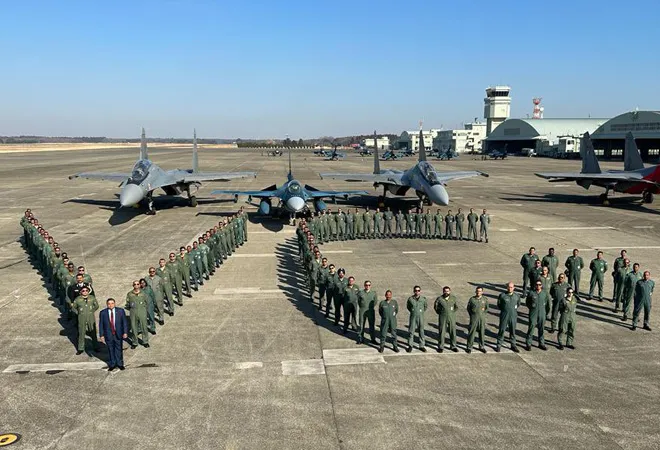
In an era of Asian strategic uncertainties and global power transition, India-Japan defence and security linkages have become particularly significant.
Baghdadi, who has led the ISIS since 2010, has acquired significant financial and military power and influence among Sunni foreign fighters. But the ISIS's violent and extremist methods have alienated Sunni militias and Baghdadi's unwillingness to share power is likely to limit the group's territorial expansion.
With tensions between an aggressive China and an emerging India intensifying, there will be significant changes and challenges in the Indian Ocean and South Asian regions
Admitting that the government's 'Make in India' initiative will result in increase in carbon emissions as it focuses on manufacturing, and industries, India's Minister for Environment, Forest and Climate Change Prakash Javedkar emphasises the need for developing countries to get cheaper access to green technology on humanitarian grounds, notwithstanding Intellectual Property Rights.