7497 results found
Prime Minister Narendra Modi and Chinese President Xi Jinping have just made back to back visits to the United States. In keeping with the times, both began their tours from that Mecca of our age - Silicon Valley.
West Bengal Governor and former National Security Advisor M.K. Narayanan recently noted that contrary to what many security and strategic analysts in the West profess, terrorism remains by all means a grave threat to the civilised world. The reality is global terrorism is expanding, especially in Asia.
In the early years of the 21st Century, we find ourselves relearning the most enduring lesson of history. That is, ¿Only thing constant in nature is change. It is not the reality that is changing but change, which is becoming a reality.¿ The difference now is that the revolution in technology is making changes, including global trends and strategic changes, faster than ever before.
As Afghanistan President Ashraf Ghani arrives in India on Saturday for the Heart of Asia (HoA) ministerial conference in Amritsar, India's Afghan policy is becoming more robust.
The late-first millennium BCE Arthaśāstra is popularly known for its vile recommendations—a perception that tends to overshadow its far more comprehensive and holistic message on state-building. While the treatise itself gives no geographical or chronological pointers, this paper takes a historicist approach to contextualise it in time and space to show that it was not a one-off product but the result of an entrenched tradition of enlightened
The Centre seems to be keen on development of Free Trade Agreements with our East Asian and South-East Asian neighbours. The general idea floated in this context is: Trade is good. More is better. But, unbridled market force in the form of unbridled trade without the concomitant safeguards in regulation and risk management mechanisms might not be a wise idea.
India can lead South Asia's war on terror by strengthening counterterrorism efforts but also lead the regional counterterrorism superstructure
After the fall of the Soviet Union in 1991, India established official ties with the five former Soviet Republics of Kazakhstan, Kyrgyzstan, Turkmenistan, Tajikistan, and Uzbekistan; so did China. In recent years, both India and China have come up with different strategies to strengthen their respective ties with these resource-rich economies, collectively called the Central Asian Republics (CARs). China’s strategy is the ambitious Belt and Roa
On the strategic side of things, Japan's economic cooperation with India is also a hedge against a rising China which is a direct threat to Japan as also India, if to a lesser extent.
An International conference on "Emerging Security Concerns in West Asia" was organised by ORF at its Rouse Avenue campus on November 21-22, 2007 in partnership with the Rosa Luxemburg Foundation of Germany.
If Obama's mandate is any guide, America is about to move to a softer, more socialised capitalist framework in which the people's welfare will be at the centre of policymaking. In a sense, America may be heading the European way in terms of pursuing social market policy.
India’s growing interests in Central Asia are well recognised.
Beyond personalities and politics, there is one basic question we need to ask ourselves: Why even 66 years after independence, is New Delhi's influence in its region shrinking instead of expanding?
For a decisive role in the region's future, India must accelerate its economic growth, build a stronger security partnership with Washington, contain the boundary dispute with China, and strengthen ties with key Asian middle powers.
We need a foreign policy approach that thinks beyond event management.
The biggest success for China insofar India is to derive maximum advantage from her emerging economy status while at the same time keeping India tied down in sub-continental squabbling. The Wen visit achieved just that.
India should put its Eurasian ambitions on hold for a while and focus on its immediate neighbourhood.
India should worry over the claim of Ansar-ul-Tawhid ul-Hind, a terrorist organisation, that Anwar Bhatkal, one of their brethren and related to Riaz Bhatkal, the founder of Indian Mujahedeen, attained what they call martyrdom battling in Afghanistan. We also cannot ignore the claims of Maulana Salman Hussaini Nadvi that he would raise a force of 5,00,000 to support Abu Bakr Al-Baghdadi.
India’s regional relations are almost all in states of distress. That’s a big problem for New Delhi.
Central Asia, which is seen by India as a potential region to explore its wider energy options in the form of hydrocarbons, hydro-electric power and uranium reserves, is apparently slipping out of its hands largely due to the energy stance of other countries.
As the annual Shangri La Dialogue in Singapore begins this week, Indian Defence Minister will not be present for the meeting suggesting that the tone of disinterest in Asian defence diplomacy set by the previous government appears to continue.
There is a chance of breaking China's hegemony in Central Asia, particularly with respect to its energy harvest, which it has consolidated.
India's exports would go down if economic sanctions are imposed on Sri Lanka as sought by some people in Tamil Nadu, affecting farmers, manufacturers and suppliers in the State, says former President of the India-ASEAN-Sri Lanka Chamber of Commerce.
Both Tokyo and New Delhi want to create a stabler Asian order by redefining partnerships in the region. Can India and Japan take the lead in this regard and form a concert of nations that would bring about balance of power in the Asia-Pacific?
Like-minded democracies in Asia are increasingly drawn together.
Both India and Russia need to start thinking strategically about the Central Asian region, not letting emotions guide their foreign policy decisions. This was the consensus reached at a conference organised recently in Delhi.
Considering the great improvement in India's relations with Bangladesh, Prime Minister Manmohan Singh, during his visit to Dhaka, should unilaterally offer to convert half of the $1 billion soft loan given to Bangladesh earlier into a grant and make the rest interest-free as a gesture of goodwill and friendship.
There have been several changes in the political landscape in the geography of Central Asia — with the entry of China as a major player in funding infrastructure projects in the region, and the weakening influence of USA in the markets, along with the independence from Soviet Union.
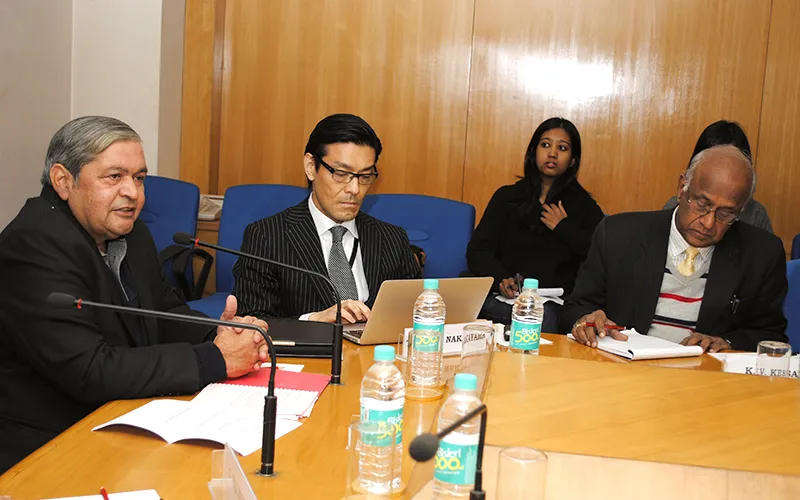
His Excellency Mr. Akitaka Saiki, Ambassador of Japan to India, addressed an eminent gathering at the ORF campus in New Delhi on June 29, 2011. In his lecture, Mr. Saiki outlined the huge potential for cooperation between India and Japan to build a strong partnership in the context of the rapidly changing security dynamics in the Asia-Pacific region. This is the text of his lecture and the proceedings of the event.
Afghanistan’s situation has thrown up challenges for New Delhi
New Delhi is trying to deepen ties to confront common threats but in-group differences pose hurdles
Many developing countries have transformed themselves from recipients into aid donors. Foreign aid donor tag is no longer exclusive to developed economies.
is paper formulates an analytical framework to assess the impacts of India's Free Trade Agreements (FTAs) on commodity value chains. Existing academic literature have relied on examining Balance of Payments (BoP) to assess the impact of FTAs. is paper views such methodology as reductionist, and instead oers alternative lenses of the impacts on the commodity value chain. is paper brings into fold the concerns for the wellbeing of various stakehold
India’s silence on developments in the South China Sea is highly unlikely to win it a lasting friendship with China but has the potential to do it some lasting damage.
Since the creation of the Association of Southeast Asian Nations (ASEAN) in 1967, Indonesia has endeavoured to play a leading role in shaping Southeast Asia’s regional security architecture; this continues to be true amidst the more recent shifts taking place in the global geopolitical landscape. Accordingly, the nature of Jakarta’s contributions towards Southeast Asian security reflects the dynamics of its national foreign policy dec
At a roundtable on "Understanding Contemporary Bangladesh", attended by vice-chancellors from nine universities of Bangladesh, the consensus view was that regional integration is not only beneficial for Bangladesh but for all of South Asia.
China and India, sooner than later, must assume regional leadership, which must be inclusive, allowing for not just coopera-tion and collaboration but the accom-modation of all stakeholders in energy. Despite their burgeoning share in energy market, both countries remain price takers rather than price makers now.
While the EU has been engaged in bilateral, regional and global efforts to enlist greater support for its Code on ICoC, one cannot say with certainty that the result has been totally satisfactory. There are still many countries that see the EU-proposed measure as problematic owing to a number of issues.