-
CENTRES
Progammes & Centres
Location
7478 results found
Of all the non-conventional renewable energy sources, small hydro represents highest density resource and stands in the first place in generation of electricity from such sources world-wide. It is also the most cost-effective energy technology to be considered for rural electrification and under the climate change scenarios.
While the launch of the MUDRA Bank is a laudable effort on the part of the government, there still persists ambiguity in the nature of the Bank's undertakings. The most pressing concern is in regards to the Bank's role as both a regulator and refinancing agency which will lead to a conflict of interests.
Building one hundred smart cities, towns or townships will not change India's urban landscape much. India needs an overall smart, well-discussed, thought-out, and lastly effective and efficiently implemented urban development strategy in a holistic urban policy framework. Now is the time to shape it.
As India starts moving on its path of making its hundred odd cities 'smart', it could take a few cues from the experience of China, another developing country and India's immediate neighbour. Though in many parameters, the Chinese cities do quite well, they too have shortcomings, when looked from some indicators.
Fixers aka political managers abound because they thrive in an artificially scare economy where votes are a premium
It is not often that China defends the rights of whistleblowers against the state and America finds itself defensive about internet freedom. That precisely is what Edward Snowden, the young American who has exposed the expansive cyber espionage activities of the National Security Agency in the United States against its own citizens and the rest of the world, has achieved.
In treating Pakistan President Asif Ali Zardari badly at the NATO summit in Chicago, US President Barack Obama was highlighting the US frustration at Pakistan's reluctance to open up over land access to the international forces in Afghanistan.
It's pointless to blame Pakistan for successful terrorist strikes. What about the CCTVs that didn't work? The strategy of the new generation of terrorists is to keep the country forever in the terror warp, and they seem to be winning.
The recent US decision to blackball People¿s War (PW) and the Maoist Communist Centre (MCC) may have revived interest in the naxalite movements, nearer home in India. While there can be no two ways about the State and the society fighting militancy, insurgency or terrorism, there is need to study the social causes and implications of such a trend. That way, we can reduce such incidents and instances, if not totally eliminate them.
Political and economic history typically studied structures and processes. Social history was interested in documenting the values, interests, and everyday lives of the common people.
Dr. V Krishna Ananth, political scientist and author, initiated an interaction on the 'Emerging scenario of coalition politics in India' at the ORF Chennai Chapter of the Observer Research Foundation, on 12 January 2008.
Social marginalisation in urban India can be overcome by identifying committed non-State individuals/institutions, and supporting them so that they are able to successfully contribute to the government's reform process.
ORF hosted a panel discussion on "Social Media and Politics", based on Shaili Chopra's book, The Big Connect: Politics in the Age of Social Media.
Hate speech, law and order, and mass panic are realities India's states have been living with for years. It would appear that, in dealing with free expression on the internet, India's politicians seem to err on the side of control. Perhaps the next election is not just about the economy, but equally about the Indian citizens freedom of expression and freedom from control.
Irrespective of whether AAP delivers on all its promises or is somehow muscled out of office in a few months, it has proven something to all Indian media watchers. Social media buzz has helped in shaping the agenda for India's largest and most important city, making a newly formed political party into a serious player in just over a year.
Aceh is a little known Northwest province of Indonesia that shot into world fame on December 26, 2004. It was the closest point of land to the epicenter of the massive 2004 Indian Ocean earthquake that triggered a tsunami. The western coastal areas of Aceh, including Banda Aceh, the capital, were among the areas hardest-hit by the tsunami. Approximately 230,000 people were killed and 400,000 left homeless out of its total population of 4.01 milli
As signaled by the Myanmar operations against militants, the policy shift in New Delhi must be taken seriously. One can hope that it does have a salutary effect on the extremist elements within the Pakistani establishment and the jihadi organisations located in the Pakistan-occupied Kashmir also.
The Telangana Rashtra Samithi waived agricultural loans and provided cash transfers. It won the Assembly election earlier this month by a landslide.
A consignment of over 100 tonnes of explosives, carried in six shipping containers. The ship was bound for Bander Abbas in Iran where the consignment was to be unlaoded and moved overland from Iran to Jaranz in Afghanistan since Pakistan does not permit such cargo to be sent from India over its territory. The consigment was of commercial grade explosives meant for use by Border Road Organization (BRO) for road construction.
India appears to have successfully climbed into the category of a nuclear "have," overcoming the divisions enshrined in the Nuclear Non-Proliferation Treaty (NPT) and enforced fervently by its adherents. However, as India prepares to argue its case for entering the export control regimes, it will find that the new "status" will bring contentious new issues, which will demand careful consideration.
This Paper analyses South Africa's position as a member of both BRICS and IBSA, especially the broader strategic implications arising out of its membership of the two organisations.
As the pressure on the new government in Jakarta increases to overtly declare its status against the Chinese in the South China Sea, it also risks falling into the 'extended coercive diplomacy' strategy of the Chinese which focuses on the coercion of an adversary aligned with the US.
China must now worry about its international reputation if it flagrantly refuses to do anything and remains rigid in its approach to the SCS dispute.
The South China Sea is seeing increasing tension amongst the claimants. The Second Thomas Shoal is the latest addition to Beijing's 'Salami Slicing' strategy of slowly acquiring small reefs and islands to consolidate its contested claim.
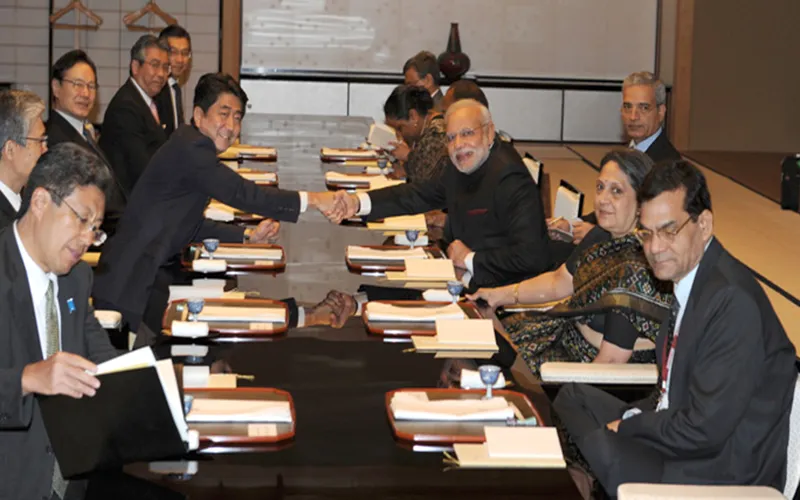
Prime Minister Narendra Modi's recent visit to South Korea has further strengthened and expanded India-Korea strategic and economic ties. Modi's call to take the bilateral relationship to a higher level was responded positively by the South Korean leadership.
South Korea has to be realistic in its approach to North Korea, according to a Korean scholar. He says South Korea still has time to negotiate as North Korea is still far from possessing "tactically meaningful nuclear devices".
The recent South Korea-EU FTA (or the KOREU FTA) is more of a steal for the Koreans than the Europeans. While it will have a 0.08 per cent impact on the European economy, it will have a 0.84 per cent impact on the Korean economy.
The combination of Indian demography, Korean technology, its value for money aspects, and the government support has made Korean companies in India quite successful, according to the Consul-General of the Republic of Korea in Chennai, Mr. Kim Kyungsoo.
Beyond 2015, South-South cooperation will have to increase and continue to support developing countries, with a special emphasis on poor and low-income countries in Asia and Africa facing sustainable development challenges.
With the Japanese crisis triggering worldwide re-thinking on the feasibility of pursuing nuclear energy to meet growing global energy demands, it is time that India, US and others looked at the option of Space Based Solar Power (SBSP).
As efforts to develop an ICoC accelerate, states need to come up with constructive ways of debating this issue. We cannot let this issue become a stumbling block that impedes progress on the code as a whole, particularly when the immediate impact of the offending language is arguably neutral.
The Japanese perspective on the Space Code is based on its diplomatic and technological concerns, not on its military and security needs. Since MoD is not engaged in the process of decision-making for the Code, it would be difficult to assume that Japan would commit to the Code for security purposes.
Australia has announced that it supports the Space Code of Conduct initiative sponsored by the European Union. A question that might well be asked is why should Australia care about such matters?
Space debris, traffic management and orbital frequency being issues that concern both India and the US, this ideally should be on the agenda in future US-India endeavours. It might be good for both the countries if they can engage in shaping this debate that would give them ownership of the issue.
Precisely because India has an interest in the normative process and institutionalising a space code, it is important for New Delhi to sit on the high table as an active party shaping the debate.