-
CENTRES
Progammes & Centres
Location
6219 results found
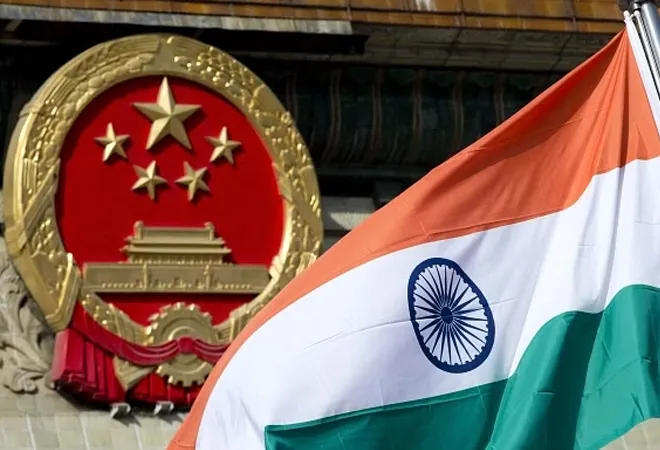
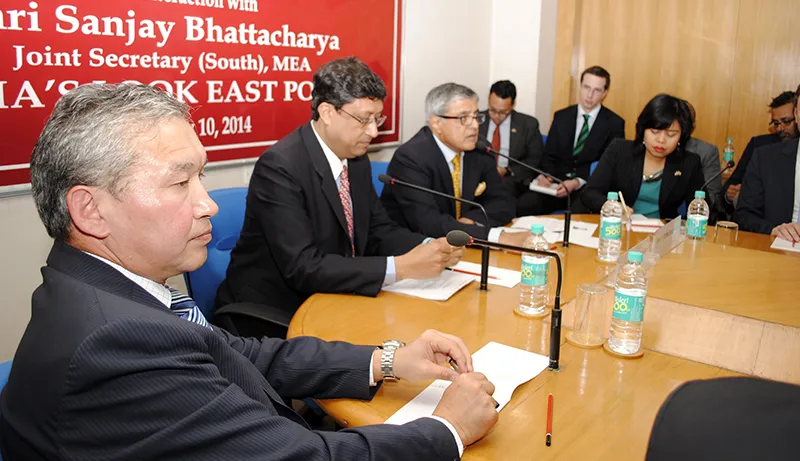
A five-member delegation from the Beijing-based China Institute of Contemporary International Relations (CICIR) exchanged views with the ORF faculty on bilateral relations, media reportage, regional issues, international terrorism, and possible areas of research cooperation
President Wickremesinghe seems to have succeeded in conveying Sri Lanka's best intentions for India during his visit.
As New Delhi intensifies the effort to bring many others home after the successful evacuation of Kerala nurses, Prime Minister Narendra Modi must create a strong institutional framework to cope effectively with the recurrent crises involving Indian citizens abroad.
( At the time of the blasts, I was on a flight from Delhi to Chennai. Immediately on my return home at 9 PM on October 29,2005, I heard of the blasts. At the request of an online journal, I had given my initial reactions in a brief write-up titled " Delhi Blasts: The Message". This article is an attempt at a more comprehensive analysis on the basis of further information available at 8 AM on October 30,2005)
Campaign trends in Delhi elections indicate that parties are playing around the issues having popular appeal rather than the hard core issues of governance, statehood or even air pollution. In varying degrees, populist ideas such as free houses, free water and free electricity remain the core poll promises for all political parties.
The shockingly stunning victory of the two-year-old Aam Admi Party (AAP) in the assembly election in the national capital this week is expected to impact the national politics in a significant manner as it is bound to trigger the process of political realignment across the country.
Charismatic, centralised leadership, like Mr Modi's today and Indira Gandhi's earlier, whilst have a huge advantage in national elections, cannot single-handedly carry a local election. Delhi is likely to make this point to leaders yet again.
India will be hosting the next India-Africa Forum Summit in 2014 and it is trying to implement as many decisions of the earlier two Summits as possible, according to a senior official at the MEA.
The relative degree of success of President Barack Obama's visit to India will depend on the extent to which the tough US demands on defence trade be eased to accommodate India's strategic needs without compromising national interests from both sides.
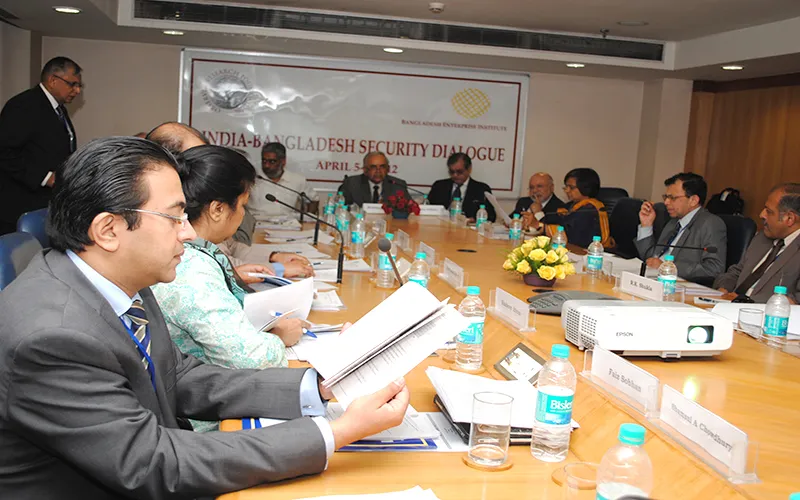
During the recent "5th India-Bangladesh Dialogue" organised in Delhi, there was consensus among all participants on the need for strengthening further cooperation on border management and counter terrorism in order of tackle threats which are common to both the countries.
The relationship has its roots in history, but both States have ensured continuous engagement, crucial for contemporary South Asian relations
As dependable allies, the India-France partnership is a force for global good in a volatile world engulfed in multiple crises
There is a genuine endeavour in the Government of the National Capital Territory of Delhi to enhance their public delivery mechanisms. And, its example of harnessing ICT can come handy for other states currently implementing Right to Service Acts.
Indo-Pak rapprochement has been stuck in a rut for some time with Pakistan insisting on tangible progress on Kashmir and India reiterating that it is necessary to first build confidence by resolving relatively less intractable problems.
The Observer Research Foundation¿s (ORF) Institute of Security Studies hosted a roundtable discussion on the ¿Demilitarisation of Siachen¿, on May 4, 2005, at ORF Campus, New Delhi. The discussion was chaired by Gen (Retd) VP Malik, former Chief of the Army Staff.
The South Asian region is witnessing some kind of democratic upsurge. For the first time, all the countries in the region have embraced democracy. Yet, democratic transitions in the region are filled with uncertainties and fragility. South Asian countries need to learn from each other's democratic experiences and support each other.
The Indian leadership has been able to earn a lot of goodwill by sheltering the Dalai Lama and his people, but after his life, the 90,000-strong community will become a political and economic burden.
One of Tunisia's leading politicians, Sheikh Rashid al-Ghannouchi, says the Middle East is not in crisis, but rather at a "crossroads." The Middle East can indeed achieve stability and peace through a process of democratic reconciliation and consensus. But the road will be long and involve building institutions, healing old wounds and forging compromises.
Though foreign policy is going to be an important issue in the US Presidential elections next year, the Democrat candidates for the party's nomination have surprisingly devoted little time to this aspect so far. However, as the campaign progresses and the less serious candidates drop out of the race, the issue is likely to gain greater attention.
With Iraq back on the chess-board of international diplomacy, there is Once again the talk of democratizing individual West Asian nations, if not West Asia as a region. Going by the neighbourhood experience in recent times, it has also raised the question if West Asia is ready to be democratized, if it is not through the barrel of the American gun.
The DeFi landscape is complex, encompassing digital assets, blockchain technology, and tokenization. Despite skepticism, it holds potential for financial inclusion, improved taxation, and democratizing investment in private markets.
Pakistani establishment would have to be out of its mind to enter Osama bin Laden's Abbotabad hideout on a white charger. Such foolhardiness would swell the ranks of Jihadi outfits in Pakistan. Murderer of Punjab Governor, Salman Taseer would resurface as a model.
Some voices in India had advocated a tough response to the Chinese. This would be untimely and irresponsible. In retrospect, the handling of the situation which involved a symmetrical non-threatening military response by Indian forces, along with patient diplomacy has paid off.
Though the Planning Commission went by the Tendulkar formula, Rs 32 and Rs 24 look extremely low at today's prices and high inflation, and especially if we take into account that these amounts include other items of daily life like education and health.
Mumbai's public healthcare sector is approaching exhaustion. The Municipal Corporation of Greater Mumbai (MCGM), despite its untiring efforts to provide affordable healthcare through its general hospitals and peripheral centres.
The manner in which to determine the relationship between India and Africa is two-fold: micro analysis and macro analysis. This includes focusing on economic and energy diplomacy, political and security engagement and pan-African projects and strategies, says Dr. Arndt Michael of the University of Freiburg, Germany.
Nepal's former Prime Minister Sher Bahadur Deuba has stressed on the need to develop "a joint approach" with India to exploit the huge hydro power potential of the country. He said Nepal has the potential of generating over one lakh megawatts of power.
Crowdfunding is a concept that refers to an open call for finances, often for innovative or unique projects and campaigns. Crowdfunding platforms act as intermediators between supporter and project, investor and investee, or lender and lendee. The platforms intermediate this process by arranging the payment process between the parties. This brief outlines the benefits of crowdfunding for improving access to financing for small and medium enterpri
The story of the Maotai town in the Guizhou province in South China is an interesting case study of developmental economics - how a relatively underdeveloped region was turned into a rich town.
Along with proposing new measures and initiatives, the Narendra Modi government should focus on completing the already proposed projects that would benefit the region like the implementation of the Kaladan Multimodal transit project with Myanmar.
Constructing a border of cooperation with Bangladesh should liberate India from one of major geopolitical constraints imposed on it by the Partition of Bengal. When he travels to Dhaka in the near future, Modi is in a position to unveil a genuine strategic partnership with Bangladesh.
Whatever be the academic arguments, the die has been cast in Dhaka for a definitive contest between the forces of progress and regression. The outcomes are likely to have a lasting impact on the subcontinent's political future and India's regional security environment. It is time Delhi's political classes paid some serious attention to the developments in Bangladesh.
Commander of the US Seventh Fleet, Vice Admiral Scott H. Swift, feels that dialogues and frank discussions are the best solution to the ongoing disputes in the Indo-Pacific region.
There is a strong feeling that the signing of a Comprehensive Economic Partnership Agreement between Japan and India has not led to the full utilisation of the potential that exists for larger trade and investment. Further efforts should therefore be undertaken to realise those ends.
The reported ban on two television news channels in Uttar Pradesh has exposed the lack of rules when in face-offs between politicians (or perhaps, ruling politicians) and the media. There were earlier reports that the Central government had requested Google to take down posts that criticised it.
The US's war in Iraq is over but it has ended in a fiasco. Iraq is unstable and Iran is emerging as the strongest force in the region.
Elections will not be won or lost because of events in Sri Lanka, but Sri Lanka could be lost because of our electoral politics. Our PM's absence in Colombo at this juncture is akin to a public snub to Sri Lanka and the vacuum that we create and show little intention or urgency to fill, can only be filled by one country - China.
Terrorism in Chechnya has three major trajectories ' first, the terrorist campaign of the Chechens and others who are a part of the international terrorist network and who derive legitimacy from Islamic fundamentalism and whose fight is not just against the alleged oppression of the Russian state, but also to establish Islamic rule in Chechnya and to facilitate its integration with the pan-Islamic world.
China's decision to sell two additional nuclear power reactors to Pakistan has dimensions that need to be better understood. China is persisting with its internationally destabilizing proliferation activity.
India, like much of the rest of the world, is faced with the twin but opposing conditions of economic potential and social concerns that need to be negotiated to realise the digital dividends from artificial intelligence (AI) and achieve sustainable and balanced growth. AI systems involve layers of technological dependencies that necessitate and enable social and institutional interdependency between stakeholders, enabling conditions, and resourc
India will become a digital society. It is also deploying all the right pieces and infrastructure for a digital economy. The foundation for both will be the cloud ecosystem, which, however, needs to be protected through a robust policy and legal framework.
People in smaller cities of India were more hopeful about the prospects of Digital India than the people in big cities which are traditionally thought of as 'tech savvy', according to a survey conducted by Observer Research Foundation.
The Gulf states are investing heavily in sovereign, sustainable, and secure data infrastructure, recasting data centres as engines of economic transformation, security resilience, and geopolitical influence.