55 results found
WTO’s e‑commerce moratorium, devised for a nascent digital economy, now curbs developing countries’ fiscal and policy space, making MC14 a test
Tensions in the Strait of Hormuz reveal how a single maritime chokepoint can disrupt energy flows, paralyse trade, and transmit regional conflict into
प्राण्यांकडून मानवामध्ये होणाऱ्या रोगसंक्रमणाचे धोके �
The global resurgence of avian influenza illustrates how zoonotic threats transcend health sectors, reinforcing the need for an integrated One Health
समय के साथ साथ भारत ने सालाना कुष्ठ रोगियों की संख्या में
Despite significant progress in reducing incidence and mortality, India’s fight against tuberculosis cannot succeed without addressing air pollution
Generative AI reduces the cost of information generation and transmission, leading to information overload and manipulation, undermining the civic par
A holistic One Health approach is crucial for tackling zoonotic diseases, focusing on prevention, collaboration, and innovation for better health secu
The Ultra Low Emission Zone (ULEZ)—a key environmental issue tied to energy transmission and transportation—has become a major focus point in the
बदलते हवामान आणि विषाणूजन्य संसर्गाचा वाढता फैलाव यामु�
With shifting climate patterns, and rising viral transmissibility, the risk of Nipah outbreaks remains substantial, thus emphasising the need for ethi
भारतातील नवीकरणीय ऊर्जा क्षेत्राबद्दल खूप आशा व्यक्त क�
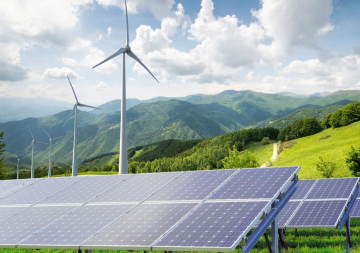
Recent headlines show India's renewable energy, especially solar, is slowing despite optimism. The government's coal focus hints at a shift.
The rising cases of malaria in SIDS need a renewed global response to mitigate climate-induced transmission and re-emergence
नवीकरणीय ऊर्जा परिसंस्थेमध्ये डिजिटल दुहेरी तंत्रज्ञा�
The use of digital twin technologies in renewable energy ecosystems will benefit producers, consumers, and governments alike
थायलंडमध्ये सुरू असलेल्या मानवतावादी संकटाला तोंड देण्
Thailand would need to implement essential refugee policies that align with international standards to deal with the ongoing humanitarian crisis
While the Nipah virus is less contagious than COVID, it is deadly and thus further studies need to be undertaken
India has played a vital role in Nepal’s quest to develop its power sector. The national forces of Nepal should take necessary steps to ensure that
India can achieve net zero only if its renewable electricity capacity reaches 1,000 GW, a proper gigawatt-sized storage is available, and a resilient
India has shied away from developing Nepal’s hydropower resources in the past, but this is changing
বৈশ্বিক অর্থনৈতিক সহযোগিতা ও পুনরুদ্ধার ভারতের জি২০ অ্�
वैश्विक आर्थिक सहयोग और आर्थिक बहाली भारत के G20 एजेंडे के �
Global economic cooperation and recovery will be key to India’s G20 agenda
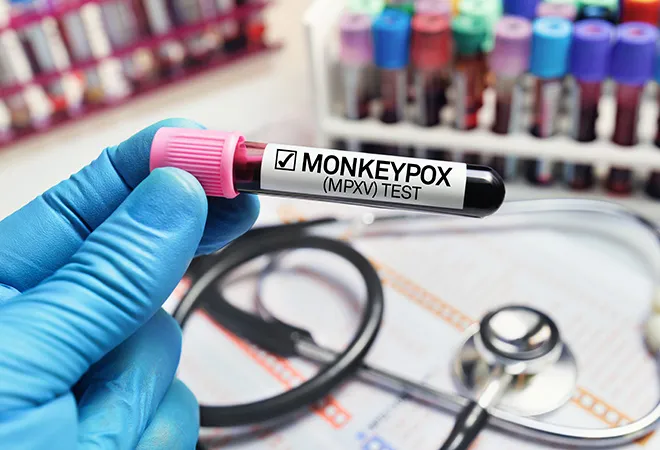
A more coordinated international response is needed to prevent monkeypox from spreading further.
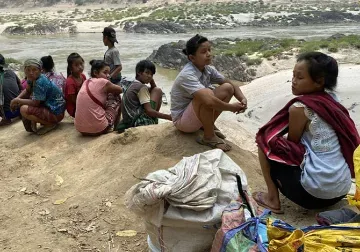
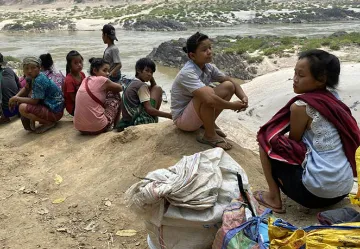
The surge of Myanmarese refugees in Thailand has made the need to reform the latter’s national refugee policy more pronounced
Guidelines on public mobility may be needed to control community transmission. However, when this is carried out in a manner that evokes fear without
India needs to create a robust and inclusive health response system employing an entire-government approach to build the resilience needed to respond
India’s preparations as well as inventory, in contrast to the vast needs that we will face in the coming days from what country examples indicate, l
If community transmission can be mitigated or avoided altogether in the small population through extraordinary human-centred measures, the Seychelles
Adopting conventional strategies may not work in India given its highly heterogeneous character.
Observer Research Foundation, in collaboration with BRIDGE TO INDIA and Solar Energy Society of India, organized a round-table discussion on "Financing the Solar Projects under JNNSM" on 9th Aug, 2011.
COVID-19, which is a highly infectious disease of zoonotic origin, serves as a serious reminder that human-nature interactions need to be based on sustainable development pathways. The recent surge in zoonotic infections in different parts of the world—among them, H1N1, Nipah virus, Zika virus, and Lyme disease—can be attributed to the intensification of human-animal contact through wildlife trade and livestock production. Reducing the rates
It can happen in the hurly-burly of politics that a flood of images abruptly wells up to the naked eye and demands attention so that we do not miss out on an entire slice of politics breaking away to get transmuted as current history.
With a number of African countries reworking their energy basket, Beijing could emerge as the partner country of choice
Kerala outbreak sparks calls for improved communication and targeted action
Smart Grid technology solutions can not only help India reduce its transmission and distribution losses, but can also help leap to the future by bundling major public utilities over one single grid.
India’s power sector requires sustained efforts to achieve the power generating capacity target of approximately 1.2 terawatts by 2047. It needs such capacity to meet the demands of economic growth and achieve the Sustainable Development Goal 7 of providing universal electricity access. At the same time, the country also needs to reduce its greenhouse gas emissions to meet commitments to global climate action agreements. This paper revi
The transmission of external shocks via trade and financial channels from advanced economies to emerging and developing economies has occurred during several turbulent episodes. This policy brief documents factors that may help build resilience to such shocks. It emphasises that G20 nations must resort to policy coordination, renew the emphasis on trade ties, strengthen the financial architecture, and enhance global supply chains to cope with the
Countering the militancy in Kashmir has become a highly challenging task due to the exploitation of new information and communication technology by insurgent groups. The battlefield is now a multidimensional one, encompassing both physical territory and cyberspace. The overall capabilities of insurgents have been enhanced by tools in cyberspace that are inexpensive, ever more sophisticated, rapidly proliferating, and easy to use. Militants are sy
The Covid-19 vaccination rollout has been slow in many parts of the world, and it might not be inaccurate to say that the newer, more transmissible variants have done a better job at immunising populations than the vaccine. More than 16 months since the global vaccination drive was started, wealthier countries have inoculated vastly higher proportions of their populations compared to the poorer ones. For example, as of late April 2022, the United
Professional diplomats will find little that is new or startling in the Wikileaks cables. For them the quality and content of reporting in the leaked cables is quite standard fare. Transmitting to Headquarters information gleaned from contacts, assessing its worth,
In the biomedical field, laboratories must ensure biosafety while managing pathogens and microorganisms in order to protect personnel and the broader community against potential leaks and lab-acquired infections. Global standards provide a roadmap for the biosafety of laboratories, underscoring the importance of their design and equipment, personnel training, waste management, and communication in preventing potential biohazards from breaching co
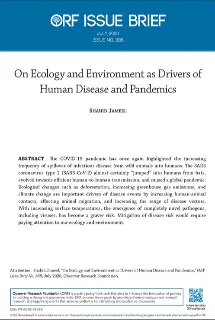
The COVID-19 pandemic has once again highlighted the increasing frequency of spillover of infectious disease from wild animals into humans. The SARS coronavirus type 2 (SARS-CoV-2) almost certainly “jumped” into humans from bats, evolved towards efficient human-to-human transmission, and caused a global pandemic. Ecological changes such as deforestation, increasing greenhouse gas emissions, and climate change are important drivers of disease
Digital financial services have benefits but pose privacy risks that harm consumers, merchants, markets, and nations alike. Some payments systems in India suffer from vulnerabilities because they were not prospectively designed on the basis of the ‘privacy by design’ principle. At the back-end, the centralised storage of data is risky. At the front-end, faulty capture devices enable data misuse. Across the middle mile, data is transmitted wit