11 results found
वाढती लोकसंख्या आणि त्याचबरोबर शहरीकरणाचा वेग वाढल्याम
The rise in population, paralleled by the increase in urbanisation, has amplified the immediate need for climate-resilient infrastructure in Indian ci
2030 पर्यंत, केवळ 77 टक्के लोकांकडे स्वच्छ स्वयंपाक इंधनाची �
By 2030, only 77 percent are expected to have clean cooking fuel, leaving 1.9 billion with traditional sources of fuels
Over the foreseeable future, only massive advances in renewable technology and storage options can reverse the tide of carbon emissions from the incre
The major achievement of the recent BRICS Summit was the decision to create the long-awaited (BRICS) New Development Bank. The bank can be seen as a growing influence of the BRICS which together represents 18% of the World trade and accounts for 40% of the global population with a combined GDP of $ 24 trillion.
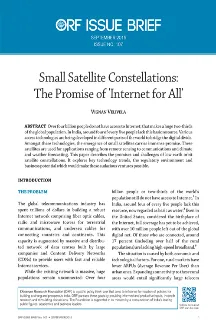
Over four billion people do not have access to Internet; that makes a huge two-thirds of the global population. In India, around four of every five people lack this basic resource. Various access technologies are being developed in different parts of the world to bridge the digital divide. Amongst these technologies, the emergence of small satellites carries immense promise. These satellites are used for applications ranging from remote sensing t
Agriculture is the second-largest emitter of greenhouse gases, even as it feeds the 8-billion global population. Around 75 percent of farms, globally, are family-owned and under 2 hectares; together they produce a third of the world’s food. These smallholder farms produce 15-percent lower emissions per hectare than a large farm. Yet, smallholders bear the brunt of climate change, which threatens their livelihood. Big agribusinesses, meanwhile,
Infrastructure development and connectivity paradigms are emerging as domains of geopolitical contestation between rival powers. This competition is fiercest in the Indo-Pacific region, home to roughly half of the global population and accounting for around 60 percent of the world's economy. China’s Belt and Road Initiative (BRI) has made advances over the past decade, delivering mixed results in furthering regional connectivity and reducing th
At least 4 billion people around the world are yet to be covered by any form of social security, and therefore vulnerable to economic, social, and environmental shocks. This paper examines the state of social security in the Group of Twenty (G20) economies—home to 63 percent of the global population. It finds gaps in social security financing in these countries: between universal coverage and actual coverage, and between countries of the Global