-
CENTRES
Progammes & Centres
Location
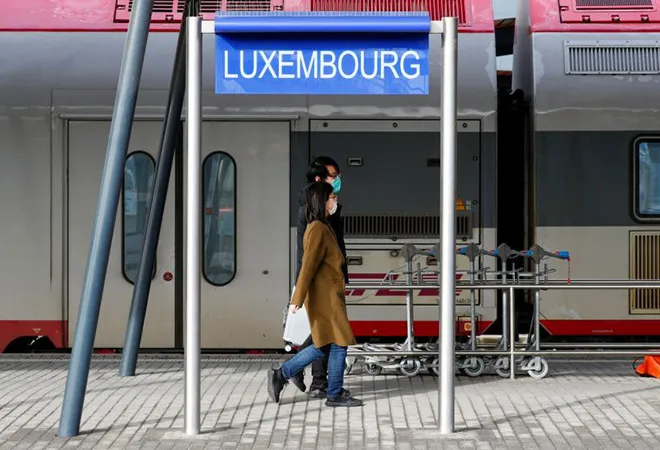 Anyone looking for an example of a country taking decisive internal measures, without simultaneously closing its borders to its neighbours, should look to Luxembourg. Officially known as the Grand Duchy, Luxembourg is a small principality, bordering French and German lands. Surveying the vistas from its capital city, two sights are particularly prominent: One of Europe’s grandest fortresses guarding the city centre, and the bridges connecting districts over a deep gorge with the river Alzette flowing through. The geographical location of the country makes it possible for it to play one of two roles: a border fortress, or a bridge between two neighbouring countries.
In these times of COVID-19 and the resurgence of nationalism globally, the instinct to put up the barricades is a natural one. In Luxembourg however, the gates have remained open. A complete closure of the country was never on the table since the economy relies heavily on the financial services and opportunities created by the European Union. Moreover, the Union’s law is safeguarded by the European Court of Justice, and a set of common financial institutions – such as the European Investment Bank – who play an active role in combating economic crises. Their offices are located in Luxembourg. Furthermore, Luxembourg’s economy is dependent on goods coming into the country, along with more than 200,000 people commuting from neighbouring Germany, France and Belgium on a daily basis. As PM Xavier Bettel put it, ‘If we close the borders, we might as well close the hospitals,’ referring to the fact that thousands of Belgian, French and German doctors and nurses cross Luxembourg’s borders on their way to work.
Thus Luxembourg, both of its own volition and by force of circumstance, continues to play the role of a vital bridge for Europe – despite two in a thousand of its inhabitants having tested positive for the virus, one of the highest ratios of COVID-19 infections globally<1>. Everyone in the country knows they’re just one handshake away from being infected, and yet the country’s schools closed only as late as 16 March. Three days later a state of emergency came into effect, with the government asking people to turn to telework if possible and not leave their homes unless absolutely necessary. Nearly all ‘third spaces’ apart from offices and homes have now been closed and social life has been whittled down to the very basics. Only essential services such as public transport, groceries, pharmacies or post offices, continue to remain operational.
However, these harsh measures were taken too little too late and only when the disease had already spread throughout the country. Luxembourg, along with the rest of the EU, was clearly not prepared for the state of epidemic emergency that transpired. Despite that, and also considering the fact that the last recorded pandemic hit the continent generations ago, the peaceful empty streets are an admittedly impressive sight. So far, there is no sign of public panic. People seem to trust the robustness of the hospital network and the fear of infection seems to be less daunting than the fear of the grim economic prospect that awaits.
As one of the continent’s financial centres, Luxembourg depends heavily on the EU’s stability. After last decade's euro crisis, the flaws of the Union’s unfinished federation were laid bare. The corona outbreak seems to have put the future of the EU at stake again. Even while healthcare is the domain of member states by treaty, the regions suffering the most instinctively turned to the EU. But, at least in the first weeks of the crisis, EU member states were mostly tending to think nationally. They secured scarce medical resources for their people, leaving other Europeans – mostly in severely affected Italy and Spain – to be taken care of by their sovereign powers. More and more EU countries were introducing border controls in places where there had been no border checkpoints visible for decades. Inter-state assistance has been scarce. The sense has persisted that it is not only COVID-19 patients who are struggling to breathe, but also Europe itself.
The initial inaction of EU institutions is now being replaced by some initiative. At the EU level, some funds are being assigned for medical aid, while the Commission is pooling medical resources for member states and coordinating their distribution in the most distressed regions. National governments are also coordinating protection of the EU’s external borders. Germany and Luxembourg recently decided to arrange transfers of some COVID-infected patients to their hospitals in order to bring relief to the overwhelmed Italian, Spanish and French health systems, in a welcome gesture of European solidarity.
It is not clear yet which approach, European or narrowly national, will ultimately prevail. As some national governments deliberate rescue packages, the growing nationalisation of European economic policy poses a real danger for the tiny Grand Duchy. Its financial institutions profit from the common currency, the euro. Its wealth is built on the income created by international corporations that chose to have a European seat here, using the common European market and tax incentives proposed by the Luxembourg government. It should come as no surprise that PM Xavier Bettel was among nine prime ministers who proposed “corona bonds”, a debt instrument to be issued together by 19 Eurozone countries, that may in time lead to a common EU debt policy - an outcome feared by many wealthier EU states. The Germans and the Dutch are not yet prepared to warrant Greek or Italian bonds, and treaties seem to forbid the issuing of debt instruments by the Union. However, the last Eurozone crisis showed that difficult times encourage brave legal interpretations.
Anyone looking for an example of a country taking decisive internal measures, without simultaneously closing its borders to its neighbours, should look to Luxembourg. Officially known as the Grand Duchy, Luxembourg is a small principality, bordering French and German lands. Surveying the vistas from its capital city, two sights are particularly prominent: One of Europe’s grandest fortresses guarding the city centre, and the bridges connecting districts over a deep gorge with the river Alzette flowing through. The geographical location of the country makes it possible for it to play one of two roles: a border fortress, or a bridge between two neighbouring countries.
In these times of COVID-19 and the resurgence of nationalism globally, the instinct to put up the barricades is a natural one. In Luxembourg however, the gates have remained open. A complete closure of the country was never on the table since the economy relies heavily on the financial services and opportunities created by the European Union. Moreover, the Union’s law is safeguarded by the European Court of Justice, and a set of common financial institutions – such as the European Investment Bank – who play an active role in combating economic crises. Their offices are located in Luxembourg. Furthermore, Luxembourg’s economy is dependent on goods coming into the country, along with more than 200,000 people commuting from neighbouring Germany, France and Belgium on a daily basis. As PM Xavier Bettel put it, ‘If we close the borders, we might as well close the hospitals,’ referring to the fact that thousands of Belgian, French and German doctors and nurses cross Luxembourg’s borders on their way to work.
Thus Luxembourg, both of its own volition and by force of circumstance, continues to play the role of a vital bridge for Europe – despite two in a thousand of its inhabitants having tested positive for the virus, one of the highest ratios of COVID-19 infections globally<1>. Everyone in the country knows they’re just one handshake away from being infected, and yet the country’s schools closed only as late as 16 March. Three days later a state of emergency came into effect, with the government asking people to turn to telework if possible and not leave their homes unless absolutely necessary. Nearly all ‘third spaces’ apart from offices and homes have now been closed and social life has been whittled down to the very basics. Only essential services such as public transport, groceries, pharmacies or post offices, continue to remain operational.
However, these harsh measures were taken too little too late and only when the disease had already spread throughout the country. Luxembourg, along with the rest of the EU, was clearly not prepared for the state of epidemic emergency that transpired. Despite that, and also considering the fact that the last recorded pandemic hit the continent generations ago, the peaceful empty streets are an admittedly impressive sight. So far, there is no sign of public panic. People seem to trust the robustness of the hospital network and the fear of infection seems to be less daunting than the fear of the grim economic prospect that awaits.
As one of the continent’s financial centres, Luxembourg depends heavily on the EU’s stability. After last decade's euro crisis, the flaws of the Union’s unfinished federation were laid bare. The corona outbreak seems to have put the future of the EU at stake again. Even while healthcare is the domain of member states by treaty, the regions suffering the most instinctively turned to the EU. But, at least in the first weeks of the crisis, EU member states were mostly tending to think nationally. They secured scarce medical resources for their people, leaving other Europeans – mostly in severely affected Italy and Spain – to be taken care of by their sovereign powers. More and more EU countries were introducing border controls in places where there had been no border checkpoints visible for decades. Inter-state assistance has been scarce. The sense has persisted that it is not only COVID-19 patients who are struggling to breathe, but also Europe itself.
The initial inaction of EU institutions is now being replaced by some initiative. At the EU level, some funds are being assigned for medical aid, while the Commission is pooling medical resources for member states and coordinating their distribution in the most distressed regions. National governments are also coordinating protection of the EU’s external borders. Germany and Luxembourg recently decided to arrange transfers of some COVID-infected patients to their hospitals in order to bring relief to the overwhelmed Italian, Spanish and French health systems, in a welcome gesture of European solidarity.
It is not clear yet which approach, European or narrowly national, will ultimately prevail. As some national governments deliberate rescue packages, the growing nationalisation of European economic policy poses a real danger for the tiny Grand Duchy. Its financial institutions profit from the common currency, the euro. Its wealth is built on the income created by international corporations that chose to have a European seat here, using the common European market and tax incentives proposed by the Luxembourg government. It should come as no surprise that PM Xavier Bettel was among nine prime ministers who proposed “corona bonds”, a debt instrument to be issued together by 19 Eurozone countries, that may in time lead to a common EU debt policy - an outcome feared by many wealthier EU states. The Germans and the Dutch are not yet prepared to warrant Greek or Italian bonds, and treaties seem to forbid the issuing of debt instruments by the Union. However, the last Eurozone crisis showed that difficult times encourage brave legal interpretations.
The views expressed above belong to the author(s). ORF research and analyses now available on Telegram! Click here to access our curated content — blogs, longforms and interviews.

Dr Krzysztof Marcin Zalewski (PhD) is President of the Board at Boym Institute a Warsaw based think tank. As a policy expert he writes about ...
Read More +

 PREV
PREV