In this world, about 771 million people still lack access to electricity. Providing basic electricity is not adequate towards attaining sustainable development, it also needs assurance of quality supply that is both environment friendly and affordable to the users. One amongst the targets of Sustainable Development Goal (SDG) Number 7 is ensuring universal access to affordable and reliable electricity by
2030. The world made progress in electrification rates leading to 90 percent of the population with access to electricity in the year 2019 from the corresponding figure of 83 percent in the year
2000. However, the Sustainable Development Goals Report 2021 indicates that, at the present pace, about 660 million people may remain without electricity by
2030. In addition to this, the COVID-19 pandemic has reversed the past progress in electricity access, says the
International Energy Agency (IEA). SDG 7 directly or indirectly supports other SDGs and reversal in electricity access rates may, therefore, influence the progress of other SDGs. This article discusses the influence of the COVID-19 pandemic on electricity access, in context of consumption as well as supply.
The author reviewed 10 shortlisted reports and research papers on electricity access published by international agencies, reputed national agencies, the United Nations (UN), and researches published in Elsevier & Wiley journals in the years 2020 and 2021. Based on the review, six most frequently indicated influences of the COVID-19 pandemic on electricity access are listed and is presented in figure 1.
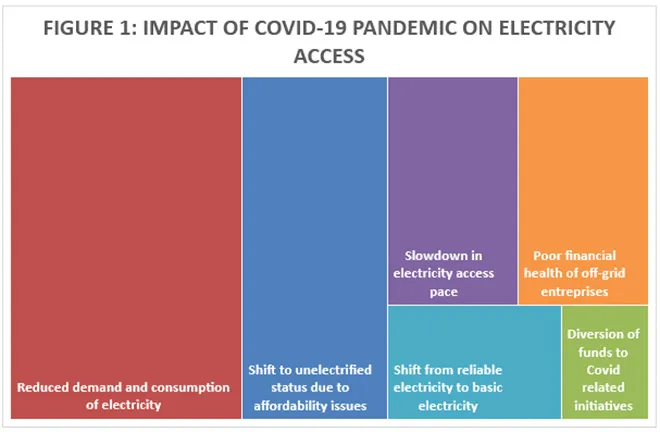 Source: Author’s own (based on review of literature)
The COVID-19 pandemic led to job losses or reduction in income across the world, more significantly amongst those engaged in the unorganised sector. About 85 million people, primarily in developing Asia, shifted to basic electricity from extended usage of electricity because of affordability
issues. For 25 million people in developing Africa and Asia, basic electricity became unaffordable due to increasing poverty
levels. Worldwide demand and consumption of electricity reduced during the lockdown majorly due to reduced economic activities and manufacturing. The governments in several countries waived or deferred payment of electricity bills by the consumers. For example, in Senegal, electricity bills were frozen for three months for vulnerable
households. The Government of Vietnam also reduced electricity bills for the households impacted by
COVID-19. However, the scenario was different for the residential sector in developed countries. A state-wise analysis of the United States indicates that the energy consumption for the housing sector increased by as much as 30 percent during the lockdown
period.
Worldwide demand and consumption of electricity reduced during the lockdown majorly due to reduced economic activities and manufacturing.
Reduced electricity consumption and considerations in tariff caused setbacks on the supply side. The International Finance Cooperation (IFC), in its report, mentions that several power distribution companies have ended contracts with the power generation companies due to reduced electricity demand and consumption along with the inability to pay by the consumers and social
considerations. In India, the reduced demand from high-paying customers during the lockdown negatively affected the distribution company’s outstanding
dues. The lockdown, to some extent, limited the bill collection processes all over the world, especially in rural locations. For example, meter reading and paying and collection of bills physically was restricted during lockdown.
Apart from the setbacks faced by users and suppliers of electricity, the governments also had to slow down their initiatives towards improving access to electricity to address the public health crisis. For example, the Government of Bangladesh had to divert significant fund from TR-Kabita programme (which aims to improve electricity access at last mile using solar off-grid technologies) to reduce impacts of COVID-19 and the Amphan
cyclone. In addition, the cost of borrowing increased significantly in the countries with higher electricity access deficits, says
IEA.
The Government of Burkina Faso announced 50 percent reduction in the cost of solar kits for the rural households and an allocation of US $500,000 relief fund was announced for the off-grid renewable energy firms in Nigeria.
The less costly way to improve access to electricity is through off-grid technologies. Solar off-grid technologies are the popular means for providing electricity access to the last miles in access poor countries. However, the pandemic also influenced the financial health of the off-grid companies as well as disrupted the supply of components. The Government of Burkina Faso announced 50 percent reduction in the cost of solar kits for the rural households and an allocation of US $500,000 relief fund was announced for the off-grid renewable energy firms in
Nigeria. The Power Africa programme redirected US $4.1 million in grants to off-grid companies for rural and peri-urban health clinic
electrification.
On the bright side, the recent report on renewable markets by IEA mentions that the renewable capacity additions in 2020 is more than 2019 by
45 percent. This increase is primarily in China, USA, and Vietnam. However, the rush for the installations were linked with policies related to tariff and tax decided prior to COVID
pandemic. For example, in Vietnam phase out of Feed-in-Tariff (FiT) for solar photovoltaic projects led to faster
installations. In India, the renewable energy capacity installations between February and May 2020 has seen an increment of
0.75 percent. However, a significant amount of auctioned capacity are facing challenges in finding
buyers.
The overall scenario indicates towards the cycle of reduced consumption of electricity due to reduced economic activities, which in turn affects the financial health of electricity generation and distribution companies. The issue needs measures at country level through policies, regulations, and other initiatives to revive the health of distribution and generation companies as well as economic activities as a whole.
The reversal in access rate of electricity is a matter of concern, especially when less than a decade is left to achieve the SDGs.
Another major impact of the pandemic is the reversal in electricity access rates due to economic reasons, especially amongst the poor, in Africa and Asia. Thirty million people in Sub- Saharan Africa may no longer be able to afford basic electricity in recent future, mentions a report released by IEA in the year
2020. The reversal in access rate of electricity is a matter of concern, especially when less than a decade is left to achieve the SDGs. The three amongst the six influences of COVID-19 directly impacts access to electricity amongst the poor; (1) reduced affordability to pay for the electricity, (2) inability of off-grid companies to continue with their services, and (3) diversion of resources allotted for electricity access.
FIGURE 2: INFLUENCE OF COVID-19 PANDEMIC ON ELECTRICITY ACCESS AMONGST THE POOR
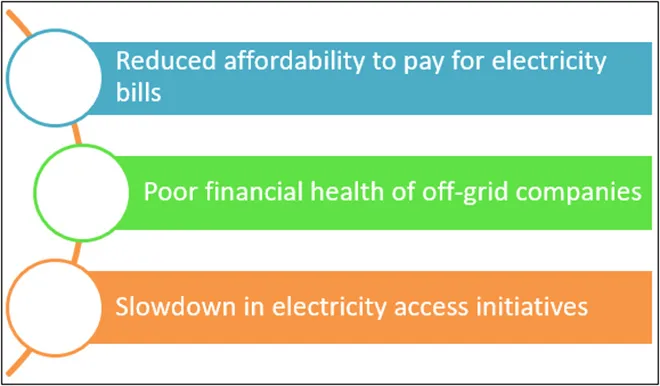 Source: Author’s own
Affordability is one of the major concerns towards sustained usage of electricity or any other energy services, even in the scenario where there is no pandemic prevailing. A survey report by Center for Energy, Environment and Water (CEEW) in the year 2020, covering about 15,000 households across India, mentions that 2.4 percent households remain un-electrified primarily for their inability to afford grid
electricity. Differential tariffs, subsidised bills, free connections are few of the measures followed by the governments across the world to make electricity affordable for the poor. The faster and cost-effective means to reach the last mile is off-grid electricity. In this challenging time, off-grid are the promising option for countries with high deficit electricity access rates. Considering the reversals in electricity access rates and reduced economic activities during COVID-19 pandemic, off-grid companies and initiatives may be strengthened to provide access to electricity in recent future. In short term, off-grid solutions have the potential towards realisation of SDGs linked to electricity access and reducing poverty in environment-friendly way. However, grid connections are much more desirable option in long run.
The views expressed above belong to the author(s). ORF research and analyses now available on Telegram! Click here to access our curated content — blogs, longforms and interviews.



 PREV
PREV