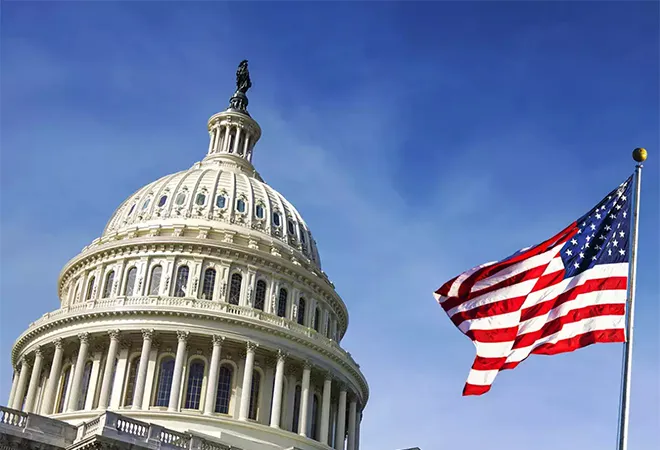
The world may have been caught up in the pageant of the Queen’s Jubilee or the war in Ukraine, but in the United States (US), a major political drama has been playing out. A Congressional committee is holding live hearings on the sensational events on January 6, 2021, when a large mob stormed the Capitol, seeking to overthrow the government.
Meanwhile, the US Supreme Court (SC) has passed a drastic ruling on abortion that has enabled or will enable more than half of the US states to virtually ban abortion and any form of birth-control. The Democrats control the Congress and the White House, but lack the votes to pass their political agenda, enabling the Right-leaning SC to pass judgments that have undermined women’s rights, environment protection and gun control laws, and have the support of only a minority of Americans.
Confronted with such a political divide and a deeper societal drift, manifested by the country’s inability to deal with gun-related violence, crime, drug abuse, homelessness and racism, many people believe that the US is in a state of irretrievable decline, especially since this is layered on expensive foreign misadventures in Iraq and Afghanistan.
But the reality is more unusual and complex.
Take conventional measures of prosperity like the Gross Domestic Product (GDP). In 1980, the US share of the world GDP was 25.16%. Today, 40 years later, the proportion is roughly the same. Even based on purchasing power parity (PPP), the US economy ranked number 9 in 1990, and dropped just one place to number 10 in 2020. What remains unique about the US, and which shows no sign of declining, is its economic strength based on its formidable science, engineering, and research and development (R&D) base. And more importantly, this seems to function almost autonomously from its political and societal problems.
The real decline is in America’s soft power, most evident recently from its inability to line up most of the world against Russia’s actions in Ukraine.
By spending some 27.3% of the worldwide expenditure on R&D, the US continues to lead the world in basic research. This has, of course, been crucially benefited by its ability to import some of the best brains in the world through the relatively open American immigration system.
The real decline is in America’s soft power, most evident recently from its inability to line up most of the world against Russia’s actions in Ukraine. Yet, though social and political events in the US may cast doubts about it being a global role model, it has not stemmed the tide of people trying to get into the country.
The structural issues bedevilling the US are obvious. It was assumed that its superior democratic and governance system would see it through any challenge. However, this system is now hopelessly gridlocked and is no longer able to function in a bipartisan manner. Gerrymandering and fraud undermine an already outdated electoral system.
The American Dream has stalled. A Harvard University project says 90% of Americans born in 1945 grew up to earn more than their parents did, while today, only half of all children earn more than their parents did. In one of the wealthiest countries in the world, 30 million Americans lack basic health insurance. At the very root of the political divide is America’s original sin — race. Today, it manifests itself in the resentment of many white Americans facing the growing political importance of non-whites.
There is, however, an American decline, and this is in relation to China. In 1980, China’s GDP was just about 1.7% of the world’s total, but today it is 17.8%. There are other areas, too, such as R&D and science, technology, engineering, and maths (STEM) education, where the Chinese are surging. By the measure of PPP, China’s GDP is already ahead of that of the US.
In the past five years, the US has become aware of this challenge, with the Joe Biden administration making strategic competition the fulcrum of its China policy. But the political gridlock that divides the US has also blocked such grand plans. Proposals for a $4-trillion investment in jobs, infrastructure, housing and clean energy have stalled though the America COMPETES Act of 2022 was passed, providing for $110 billion for basic and advanced technology research over a five-year period. Congress is politically game to fund plans to enhance US economic competitiveness, but not to fix the chronic social problems of America’s deeply divided society.
Proposals for a $4-trillion investment in jobs, infrastructure, housing and clean energy have stalled though the America COMPETES Act of 2022 was passed, providing for $110 billion for basic and advanced technology research over a five-year period.
The US continues to possess enormous geopolitical power, not in the least through geography that keeps it apart from factious Eurasia. Even beyond its technological prowess is its continuing demographic advantage. Where China and Russia are already caught up in severe demographic headwinds, high immigration levels and birth rates will ensure that the US’s working-age population will continue to expand till the 2050s and, more importantly, benefit from the superior quality of US education. In this period, the Chinese working-age population will shrink by an astonishing 100 million.
But it’s no secret that the US has its problems: The anti-immigrant sentiment is high, inequality is rising, racism persists, and gun violence is out of control. But to fix these, it needs to repair its politics, which can poison the whole system. It is essential, therefore, that the perpetrators of January 6 do not go unpunished.
The future is not cast in stone. But even a country with gifts as unique as the US will get no free pass to get there.
Manoj Joshi is distinguished fellow, Observer Research Foundation, New Delhi The views expressed are personal.
This commentary originally appeared in Hindustan Times.
The views expressed above belong to the author(s). ORF research and analyses now available on Telegram! Click here to access our curated content — blogs, longforms and interviews.



 PREV
PREV