“Tell me how it ends,” is the common refrain of generals and leaders when in the middle of a war. The
Ukraine war is no exception. Neither President Volodymyr Zelensky or his western partners, nor his Russian adversary, President Vladimir Putin, can predict how the war will end.
Earlier assumptions have been upended — Russia’s short ‘special military operation’ to ‘de-Nazify and de-militarise’ Ukraine is already a nine-month-war, and likely to extend into 2023; trans-Atlantic North Atlantic Treaty Organization (NATO) unity under U.S. leadership despite visible internal differences has not collapsed; Mr. Zelensky’s emergence as a wartime leader is surprising; and, poor Russian military planning and performance, a shock. For the present, Russia is too strong to lose and Ukraine, despite NATO support, too weak to win; so, the war grinds on with no ceasefire in sight.
After deliberating with his core group of advisers, he rejected the idea of an invasion or a nuclear threat against Moscow, and on October 22, declared a naval ‘quarantine’ of Cuba.
Yet, there is one outcome that must be prevented — a breakdown of nuclear deterrence. Nuclear weapons have not been used since 1945 and a global conscience has sustained the nuclear taboo for over 75 years. None of the three principals in Ukraine would want the taboo breached. However, escalation creates its own dynamic.
Lessons from Cuba
It is time to revisit the sobering lessons of the
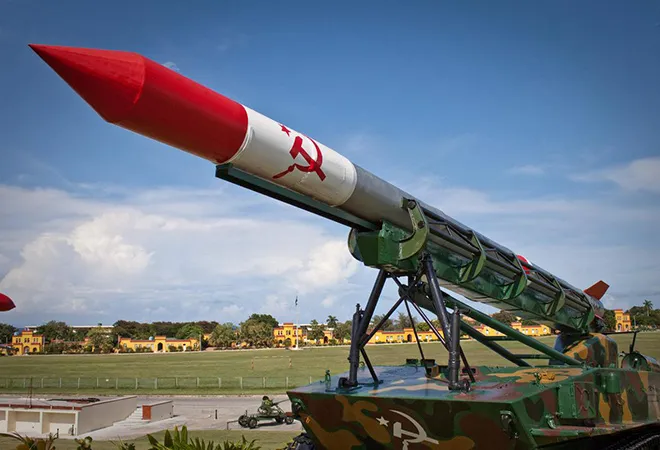
Cuban Missile crisis (October 1962) that brought the world to the edge of nuclear Armageddon, as the U.S. and the U.S.S.R. engaged in an eyeball-to-eyeball confrontation. On October 16, 1962, U.S. President John F. Kennedy was informed that that the U.S.S.R. was preparing to deploy medium and intermediate range nuclear missiles in Cuba. After deliberating with his core group of advisers, he rejected the idea of an invasion or a nuclear threat against Moscow, and on October 22, declared a naval ‘quarantine’ of Cuba. Simultaneously, he authorised his brother Robert Kennedy to open a back-channel with Soviet Ambassador Anatoly Dobrynin.
The crisis defused on October 28; based on assurances conveyed through the back-channel, Soviet Premier Nikita Khruschev announced that Soviet nuclear missiles and aircraft would be withdrawn in view of U.S. assurances to respect Cuba’s territorial integrity and sovereignty. What was kept a secret by both leaders was the fact that reciprocally, the U.S. also agreed to withdraw the Jupiter nuclear missiles from Turkey.
Yet, there were plenty of unforeseen events. On October 27, a U.S. surveillance flight strayed over Cuban airspace and was targeted by Soviet air defence forces. Major Rudolf Anderson was shot down, the only casualty. This happened despite Kennedy having counselled desisting from provocative surveillance and Khrushchev not having authorised the engagement. Both sides kept the news under wraps till the crisis defused when Major Anderson’s sacrifice was recognised and honoured.
The U.S. was unaware that the submarine was nuclear armed and Captain Valentin Savitsky did not know that a quarantine was in operation.
A day earlier, a Soviet nuclear armed submarine B-59 found itself trapped by U.S. depth charges, off Cuban waters. The U.S. was unaware that the submarine was nuclear armed and Captain Valentin Savitsky did not know that a quarantine was in operation. He decided to go down fighting but his decision to launch a nuclear bomb was vetoed by Capt. Vasily Arkhipov. The Soviets followed a two-person-authorisation-rule and unknown to Kennedy and Khrushchev, a potential Armageddon was averted.
The most shocking revelation emerged decades later when the U.S. learnt that unbeknownst to them, over 150 warheads for the FKR-1 Meteor missile, short range FROG missile, and gravity bombs were already present in in Cuba. These were intended for defence in case the U.S. launched a repeat of the 1961 failed
Bay of Pigs invasion. Despite Cuban leader Fidel Castro’s opposition, Premier Khrushchev insisted on withdrawing these too, conscious that these could provide the spark for a future escalation.
The key lesson learnt was that the two nuclear superpowers should steer clear of any direct confrontation even as their rivalry played out in other regions, thereby keeping it below the nuclear threshold. Deterrence theorists called it ‘the stability-instability-paradox’. With their assured-second-strike-capability guaranteeing mutually-assured-destruction, both the U.S. and the U.S.S.R were obliged to limit the instability to proxy wars. Nuclear war games over decades remained unable to address the challenge of keeping a nuclear war limited once a nuclear weapon was introduced in battle.
Russia’s nuclear signalling
The Ukraine war is testing the old lessons of nuclear deterrence. Russia sees itself at war, not with non-nuclear Ukraine, but with a nuclear armed NATO. Mr. Putin has therefore engaged in repeated nuclear signalling — from being personally present in mid-February at large-scale exercises involving ‘strategic forces’, to placing nuclear forces on ‘special combat alert’ on February 27.
Nuclear war games over decades remained unable to address the challenge of keeping a nuclear war limited once a nuclear weapon was introduced in battle.
He raised the stakes again on September 21 when he ordered a ‘partial mobilisation’, announced referendums in the four regions of Luhansk, Donetsk, Kherson and Zaporizhzhia, accused the West of engaging in nuclear blackmail and warned that Russia has ‘more modern weapons’ and ‘will certainly make use of all weapon systems available; this is not a bluff’. He cited U.S. bombing of Hiroshima and Nagasaki in 1945 as a precedent.
However, Russian nuclear use makes little operational sense. In 1945, Japan was on the verge of surrender and only the U.S. possessed nuclear weapons. Use of a tactical nuclear weapon will only strengthen Ukrainian national resolve; NATO response is unlikely to be nuclear but will be sharp. International political backlash would be significant and Mr. Putin may find himself increasingly isolated. Many countries in East and Central Asia could reconsider nuclear weapons as a security necessity.
Role for global diplomacy
During the next few weeks, the fighting in Ukraine will intensify, before winter sets in and the weather freezes military operations till spring. This raises the risks for escalation and miscalculations. Right now, the goal of a ceasefire seems too distant, though eminently desirable. The United Nations appears paralysed given the involvement of permanent members of the Security Council. Therefore, it is for other global leaders who have access and influence, to convince Mr. Putin that nuclear escalation would be a disastrous move.
Use of a tactical nuclear weapon will only strengthen Ukrainian national resolve; NATO response is unlikely to be nuclear but will be sharp.
Indonesia is the
G20 chair and President Joko Widodo will be hosting the summit meeting next month. India is the incoming chair; Prime Minister Narendra Modi will be attending the summit. Both Indonesia and India have refrained from condemning Russia, keeping communication channels open. In a bilateral meeting with Mr. Putin in Samarkand last month, Mr. Modi emphasised that “now is not the era of war”. In the run-up to the G-20 summit, Mr. Widodo and Mr. Modi are well placed to take a diplomatic initiative to persuade Mr. Putin to step away from the nuclear rhetoric. This means emphasising the deterrent role of nuclear weapons and not expanding it; to reiterating Russia’s official declaratory position that restricts nuclear use for “an existential threat”.
Such a statement would help reduce growing fears of escalation and may also provide a channel for communication and open the door for a dialogue that can lead to a ceasefire. The lessons of the Cuban Missile crisis remain valid 60 years later.
This commentary originally appeared in The Hindu.
The views expressed above belong to the author(s). ORF research and analyses now available on Telegram! Click here to access our curated content — blogs, longforms and interviews.



 PREV
PREV