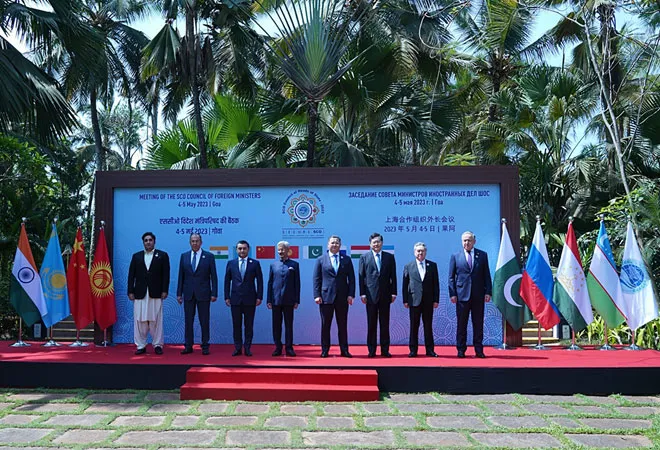
India took its eyes off the G-20 these past two weeks, as the Shanghai Cooperation Organization (SCO) took centrestage, hosting the defence and foreign ministers of the grouping. For New Delhi, the chairmanship of both the G-20 and the SCO together calls for a delicate balancing act at a time when the Eurasian turmoil is leading to a shift in the global balance of power equations. With the theme of its SCO chairmanship being "Secure SCO," India has been underlining that regional security in its northern frontier continues to be a matter of priority for a nation that has increasingly global aspirations.
Yet the SCO is a strange beast. It was conceived at a time of American unipolarity when Russia and China were increasingly concerned about the growing influence of the US in Central Asia in the immediate aftermath of the end of the Cold War. Moscow wanted to preserve its influence in its"near abroad" and it thought that bringing Beijing in would help keep the US off balance in the region. When it was established in 1996, China saw it as an instrument of exploiting economic opportunities in Central Asia. For both Russia and China, this was an instrument to keep NATO out of a key region at a time when NATO's attraction was at its zenith in the post-Soviet world. The SCO charter revolved around the "three evils" of separatism, extremism and terrorism, underscoring the desire of Moscow to stabilise the post-Cold War territorial boundaries so as to retain the last remnants of regional influence.
India's engagement with the SCO has evolved along an interesting trajectory. As New Delhi started building a strong partnership with Washington after the end of the Cold War, it remained skeptical of how far this engagement would go. In order to preserve its strategic space, it also joined Moscow and Beijing in expressing its discomfort with the America's hyperpuissance, resulting in a Russia-India-China trilateral first and then a broader coalition of then emerging powers, BRICS (Brazil, Russia, India, China and South Africa). There was a hope in New Delhi that with Moscow's help it would be able to balance Beijing's growing clout.
The SCO charter revolved around the "three evils" of separatism, extremism and terrorism, underscoring the desire of Moscow to stabilise the post-Cold War territorial boundaries so as to retain the last remnants of regional influence.
But when it came to the SCO, India had pragmatic considerations that led gradually to a serious outreach. Much as New Delhi's strategic imagination has shifted to the maritime space in leveraging the nation's centrality in the Indo-Pacific discourse, India's major challenges continue to be continental in nature. The opportunities of the maritime south can only be exploited fully if the constraints imposed by the continental north are managed effectively. This calls for a substantive engagement with Eurasia.
As India's footprint grew in Afghanistan after 2001, it became even more critical that India's outreach to Central Asia remains substantive.
To manage terrorism and extremism internally, India has to remain engaged with its northern periphery, and this led India to finally join the SCO as a full member in 2017. But as the recent week's meetings (defence and foreign ministers) have shown, the terrain remains a difficult one for New Delhi as bilateral ties with China and Pakistan have nosedived in recent years.
Given India's historical and civilizational ties with its Central Asian neighbours, the SCO membership allows India to retain its presence in a highly contested geography. Yet, the principles of sovereignty and territorial integrity of nations, non-interference in internal affairs, and mutual understanding and respect for opinions of each of them - the bedrock of SCO - have been challenged by SCO members themselves.
New Delhi, therefore, kept the focus on the issue of terrorism at the SCO when External Affairs Minister S Jaishankar underscored for the SCO members, in the presence of Pakistani foreign minister Bilawal Bhutto Zardari, that taking the "eyes off terrorism" would be detrimental to the security interests of the grouping and that when the world was engaged in facing the Covid-19 pandemic and its consequences, the menace of terrorism continued unabated. India also addressed China directly when in the context of the China-Pakistan Economic Corridor, Jaishankar made it clear that while connectivity is good for progress, it cannot violate the territorial integrity and sovereignty of states. More broadly, Sino-Indian relations are passing through a tough phase and the abnormal situation along the LAC remains a problem not only for New Delhi but also for the SCO. There is a good reason why there was more interest in India in the bilaterals than in the SCO meeting itself.
India also addressed China directly when in the context of the China-Pakistan Economic Corridor, Jaishankar made it clear that while connectivity is good for progress, it cannot violate the territorial integrity and sovereignty of states.
India has proposed four joint statements, on cooperation on de-radicalisation strategies, promotion of millets and sustainable lifestyles to address climate change and digital transformation, to be adopted at the SCO leaders summit later this year. This is an attempt by India to leverage the SCO platform to push its priorities on the agenda. But the challenge for India is likely to get tougher if the present trends continue. The China-Pakistan axis will continue to limit India's ability to shape the SCO agenda on terrorism and extremism and Russia's growing closeness to China will impact New Delhi's push for a greater profile in Central Asia.
India's continuing struggle to push for the inclusion of English as the third official language of the SCO is symptomatic of this larger problem.
New Delhi has critical equities to preserve in Eurasia. As such, it will continue to engage with the SCO but how much diplomatic capital India will invest would depend on how far the grouping can deliver on Indian priorities. The SCO, like other global and regional institutions, is being reconfigured by the rapidly evolving balance of power. India's relationship with the SCO will also be a function of the reconfiguration.
This commentary originally appeared in NDTV.
The views expressed above belong to the author(s). ORF research and analyses now available on Telegram! Click here to access our curated content — blogs, longforms and interviews.



 PREV
PREV