In early June 2022, a
team led by JP Singh, the Joint Secretary heading the Pakistan–Afghanistan–Iran desk at the Indian Ministry of External Affairs, visited Kabul and met with senior Taliban ministers.
While India made it clear that none of this implied recognition of the Taliban government, the Taliban
played up the political significance of the visit.
New Delhi moved quickly to assert itself as a significant stakeholder in Afghanistan after the fall of the Ghani government. While India gives off the impression it is playing a lone hand, it is actually acting in
close coordination with the United States on the basis of shared interests. Both nations seek to stabilise the country, promote an
inclusive government and deny the space to militant groups. US Special Representative for Afghanistan Tom West held talks with Indian officials in May 2022, as well as with Abdullah Abdullah, the former chief executive of Afghanistan in New Delhi.
India has many reasons to foster closer relations with Afghanistan. The press release accompanying Singh’s visit spoke of India’s ‘historical and civilisational ties’ — but its policy is driven primarily by fears that a Taliban-run Afghanistan would enhance Pakistan’s geopolitical heft
The Taliban itself is not seen as a threat to India, but its ties with Pakistan and jihadi groups such as Lashkar-e-Tayyiba and Jaish-e-Mohammad are worrisome. Afghanistan is important to India’s continental economic aspirations, including closer ties with
Central Asia and Iran. These goals are currently hampered by Pakistan’s blockade of Indian access to the region.
The Taliban itself is not seen as a threat to India, but its ties with Pakistan and jihadi groups such as Lashkar-e-Tayyiba and Jaish-e-Mohammad are worrisome.
The bottom line is summed up by the title of SOAS University of London academic Avinash Paliwal’s study of India’s Afghan policy, ‘
My Enemy’s Enemy’. The Taliban may have close ties with Islamabad, but historical relations between Afghanistan and Pakistan have not been friendly — especially when they dispute the Durand Line (the Afghan–Pakistan border) and the status of ethnic Pashtuns who live across Pakistan and Afghanistan. Indeed, the Taliban is providing sanctuary to the anti-Pakistan insurgent group Tehreek-e-Taliban Pakistan (the Pakistani Taliban).
The Pakistan–Taliban relationship
remains complicated. The interim Taliban government had a strong pro-Pakistani faction based on the Haqqani Network, an Islamist militant organisation founded in the 1970s that now operates as a prominent part of the Taliban. Instead of helping Pakistan control the Tehreek-e-Taliban Pakistan, the Taliban is
working to clinch a long term peace deal to end their 14 year old insurgency against Islamabad — a deal that would require significant concessions from Pakistan.
A stabilised tribal region on both sides of the Durand Line would reduce violence in both countries and block the resurgence of groups like the Islamic State of Khorasan Province (ISIS-K) and Al Qaeda. But this would not ease India’s worries over the access Pakistani jihadi groups may have to Afghan territory. To achieve that, India will need leverage over the Taliban, while ties with New Delhi would provide the regime in Kabul with a means of balancing Pakistan.
In November 2021, India’s National Security Advisor Ajit Doval hosted the Third Regional Security Dialogue on Afghanistan in New Delhi. India made it clear that its aim was not to
resurrect an alliance to overthrow the Taliban, but that it sought to prevent the revival of outfits like ISIS-K and Al Qaeda. This theme of non-interference in Afghanistan’s internal affairs was repeated in the June 2022 talks.
India announced in February 2022 that it would
provide 50,000 tons of wheat to Afghanistan for humanitarian relief and that, in an unusual concession, Pakistan has allowed these shipments to travel overland through its territory. India has been the region’s largest provider of development assistance to Afghanistan since 2001, having invested US$3 billion in infrastructure projects ning schools, roads, dams and hospital — all of which increase their leverage over the Taliban.
Much will depend on the evolution of the
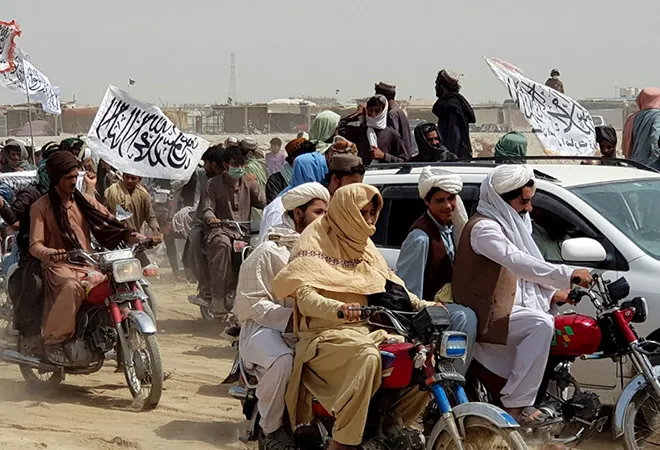
Taliban 2.0. Without a supreme leader like the 1994 founder of the first Islamic Emirate of Afghanistan, Mullah Omar, the new Taliban faces challenges along tribal, regional and personal divides.\
India has been the region’s largest provider of development assistance to Afghanistan since 2001, having invested US$3 billion in infrastructure projects ning schools, roads, dams and hospital — all of which increase their leverage over the Taliban.
New Delhi has signalled its willingness to enhance ties with Kabul in a calibrated fashion — it is considering permitting Afghanistan’s national carrier to resume flights to India and has posted a ‘technical team’ in its embassy in Kabul to provide consular services to Afghans. The big challenge for India and the United States is to assuage Pakistani fears that India’s presence in Afghanistan is a threat to its security. Islamabad has, in the past, had its proxies attack Indian targets — including the Indian Embassy in Kabul.
The 18 June 2022
bomb attack on a Sikh gurdwara in Kabul, which was claimed by ISIS-K, has sent alarm bells ringing in New Delhi. India formerly depended on a friendly Kabul government and the US security presence in Afghanistan for its security until August 2021. It must now carefully assess the lay of the land.
The best way to achieve this would be to deal directly with Islamabad. But since this is a bridge too far at present, the alternative is to move in lockstep with other stakeholders — particularly the United States, China, Russia and Central Asian countries.
This commentary originally appeared in East Asia Forum.
The views expressed above belong to the author(s). ORF research and analyses now available on Telegram! Click here to access our curated content — blogs, longforms and interviews.



 PREV
PREV