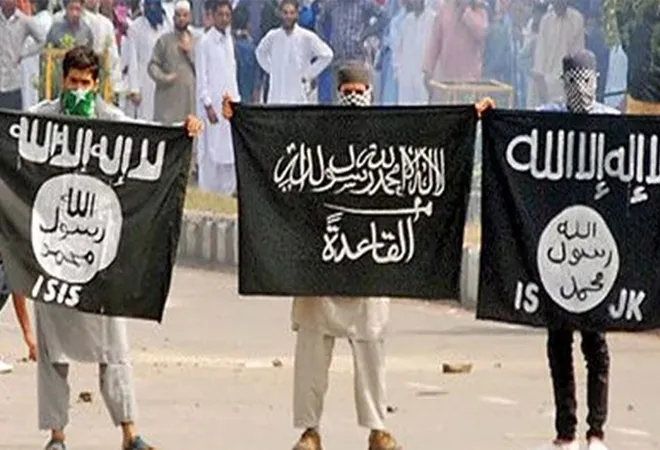
In the aftermath of the Islamic State declaring itself in July 2014, it managed to mobilize more than 30,000 people who travelled to its strongholds in Iraq and Syria. Yet, apart from approximately 100 people (divided into a few batches), scarcely any people travelled to join the Islamic State abroad too. Most of the people who did travel to the conflict zones were from the southern state of Kerala with a few more from states like Maharashtra.
Motivations for these India fighters ranged from wanting to help support oppressed Sunnis against the brutalities of the Syrian president Bashar al Assad, to seeking a sense of identity, a desire to be in a pure ‘Islamic’ atmosphere, and even adventure. This was apparent in the statements of Indians who went to Afghanistan to join the Islamic State in 2017. IS’ propaganda which also expanded to previously untapped languages (for Jihadists) such as Malayalam and Tamil also helped the group gain some currency in non-Urdu speaking regions.
Another facilitating factor was the ties of kinships since many Indians travelled either with their families or friends, a finding that is consistent with studies looking at foreign fighters from other nations. The larger question among policy makers seems to be why has there been such less numbers of foreign fighters from India (including conflict zones like Kashmir)? I argue that this has taken place due to a range of factors.
The Afghan Jihad and the Missing Indians
Perhaps no recent historical conflict has played a stronger role in helping Jihadist groups across the world as much as the Afghan Jihad in the 1980’s. Set in the backdrop of the cold war, the resistance of the Afghan Mujahideen against the Soviet Union was supported by the United States via funding and press releases in its bid to dislodge the USSR as the then superpower. Most Muslim majority countries that were aligned with the US took this one step further by sending in volunteers who entered Afghanistan via Pakistan where they received weapons and training.
According to scholars like Mohammed Hafez, many of these volunteers took part in other conflicts such as in Bosnia and Chechnya and starting networks in their home countries. These eventually became Jihadist groups such as Al Qaeda in the Arabian Peninsula (AQAP), Lashkar e-Taiba and Harkat ul-Jihadi al-Islami Bangladesh (HUJI – B).
In this context, the Indian Muslim population was largely absent in the Afghan Jihad. This happened because of various reasons. Firstly, the Indian government was slightly tilted in favor of the USSR, best displayed in its refusal to condemn the Soviet invasion. Secondly, due to Pakistan’s role as a central node that helped channel funding, weapons and fighters, it was opposed to the Jihad knowing that veterans would likely be let loose on India after the war ceased.
Thirdly, this opposition to the Jihad was why influential organizations such as the Deoband in India (whose Pakistani and Afghan counterparts funneled the most fighters in the Afghan Jihad) explicitly forbade participation in it, likely due to their proximity with the then Prime Minister Indira Gandhi. Fourthly, the Shah Bano situation, the Ram Janmbhoomi movement and resultant communal riots had captured the attention of Muslim public and leaders who were more concerned with domestic issues of majoritarianism rather than supporting international conflicts.
This reluctance to join the Afghan Jihad which was a result of the Indian government’s foreign policy alignment combined with the Muslim population’s domestic concerns were the likely reasons that why no Indian was reported fighting in the conflict. The lack of fighters meant that no veterans would come back with combat training, weapons expertise or violent ideological leanings thereby preventing a Jihadist network from taking roots in the nation.
Religion, Family and Bureaucracy: Hurdles in the path of Indian Foreign Fighters
Yet, West European nations which barely had a Muslim population in the 80’s still contributed a surprising number of recruits to the Syrian conflict which was largely attributed to them being marginalized minorities. Indian Muslims despite being a marginalized minority, the numbers were still low. This lack of Indian foreign fighters then can be due to a combination of other reasons;
- Indian Muslim Identity: In contrast to European Muslims, the Indian Muslim identity is largely well entrenched within the functioning of the nation given the millennium old presence of the community. Indian Muslims have a sense of identity that is often attached to India rather than countries outside. Indeed, this sense of not belonging to their own nation was a strong reason for European Muslims to have migrated to Syria/Iraq where they believed they would become a part of the Muslim caliphate. Especially in the 2019- 2020 anti-government agitations, the Muslim community has further asserted this identity via organizing protests and verbal commitments to the constitution of India demonstrating a strong national sense of belonging here.
- Religious Pushback: Historians like Muzaffar Alam have documented how Indian Muslim rulers since the 1200’s had encouraged strong inter-religious harmony to ensure that the majority Hindus did not revolt frequently. Thus, the theological trends that were politically engineered in medieval India became a mainstay of post-independence India. Indeed, the Barelvi movement, the Ahle Hadeeth movement, the Salafist movement, the Jamaat e-Islami and the Tablighi Jamaath have condemned various forms of terrorism. As Adil Rasheed remarked, if Indian Muslims wanted to join any Islamic State, they would have gone to Pakistan instead of staying back in India in 1947. As such, religious pushback came not just from Sufis who are touted as moderate Muslims in India but many other groups as well.
- Family Structure: Nor is this pushback only from clerical establishments. Large Indian families are often tight knit leaving them well placed to recognize signs of radicalization among their youth and take preventive steps creating a community policing system of sorts. According to Rajnath Singh during his tenure as a Home Minister, Indian Muslim families often informed the authorities if they suspected their members’ interest in partaking in terrorist activities abroad.
- Logistical Difficulties: For those individuals who did have all the necessary religious and ideological backing, there were many logistical hurdles to pass through. The passport ownership rate in India stood at 5% in 2017, with Muslims (of whom more than 67% live in poverty) plausibly comprising an even smaller group. For those few who undertook the long process of obtaining a passport, the visa requirements to enter Turkey for Indians were quite strenuous including details of return tickets, stay, work in India and full itinerary – factors that further slowed down aspiring foreign fighters whereas all it took for European foreign fighters was a passport and a ticket. Indeed, as researcher Kabir Taneja noted, many aspirants gave up their ambitions simply due to the difficulties in obtaining a passport. Added to this, the idea of travelling to a foreign conflict-ridden land where Arabic (a non-India Muslim language) is spoken without any combat training made it even easier for Muslims to stay back.
- Racism among ISIS – While it is unsure if it was true or planted by intelligence agencies, news that Indian fighters were considered poor fighters resulting in them being forced to clean toilets or becoming unwitting suicide bombers was also disseminated in many Indian media channels. This was possibly communicated to aspiring Indian fighters shattering IS’ narratives of being a shining beacon of racial and national harmony, thus, further reducing the appetite of Indians to partake in the conflict.
Government interventions
It would be folly however, to not include government action and intervention as another set of factors that has contributed to reticence on the part of Indian foreign fighters. Some of these actions are as follows below:
- Online campaigns – According to Intelligence Bureau reports, in 2014, more than 3,000 individuals went online to look for ways to join the Islamic State. The IB in response, launched operation Chakravyuh whereby IB officials posed as IS recruiters and recorded particulars of large number of aspirants after gaining their trust and then revealing their identities. Although, they did not arrest these individuals, the fact that IB officials were aware of such details plausibly scared aspirants into not trusting any real IS recruiters too helped in bringing down the numbers. Again, if this news were not true, the dissemination of it was quite effective.
- Counter Terrorism Co-operation – With many Indian Muslims situated in the Gulf nations, their roles in identifying, arresting and deporting IS cells was instrumental. The nations have been used as nodes by previous batches of Indian foreign fighters and that the governments disrupted such cells showed that they were concerned and were blocking travel routes for potential Indian foreign fighters. Such deportation stem from India’s burgeoning relations with the Gulf nations ever since the 2000’s.
- Active intervention – The Indian government also denied Shia volunteers (reportedly 250 000) permission for going to Iraq to protect Shia holy sites when they asked the Indian government for permission. If this support was not rhetorical, the consequences of sending so many volunteers to a highly sectarian and militarized region with Shia battalions like the Kataib Hezbollah and Asa’ib ahl ul Haq who had committed brutalities against Sunni Muslims would be catastrophic for the Indian Muslim community. In this regard, India’s policy of balancing its relations with Syria, the Gulf nations and Iraq (all different actors in the Syrian conflict) proved to be beneficial for the nation.
Policy Implications and the Future of Indian Fighters
Adil Rasheed classified Jihadist terrorism in India into three types being homegrown, Pakistani inspired and transnational (referring to AQ and IS). Within this, transnational jihadists often have the option to conduct attacks in India or participate in conflicts abroad. While the strategic community feared an Indian foreign fighter presence and subsequent threat of returnees, the numbers have been low. As documented above, each factor is not enough to prevent a foreign fighter exodus. Rather, it is the combination of these factors that has made a difference. This presents several lessons for security agencies.
Firstly, there are many unintended consequences of foreign policy decisions like India’s position on the Soviet invasion of Afghanistan. While such unintended consequences are clearer as in the case of Pakistan and its support for Jihadists leading to blowback, there is lesser emphasis on how this has prevented a Jihadist mobilization. Should security communities understanding this better, their capacity to analyze international conflicts with a focus on such radicalization will play a role in preventing the phenomenon.
Secondly, working with the Muslim community, which has renewed its Indian identity in the last few months, is of paramount importance to preventing foreign fighter exoduses. Be it through encouraging better communal relations, facilitating communal policing or softer approaches to de-radicalization, the government can benefit massively from the otherwise impossible task of policing more than 150 million Indian Muslims.
Thirdly, government disinformation campaigns to tackle terrorist propaganda can have multiple positive ripple effects for a long time as seen in the case of operation Chakravyuh. If security agencies continue to persist with incisive campaigns that target Jihadist groups instead of communities, there is a higher chance that future waves of foreign fighters will not comprise of Indians.
The recent killing of a Tamil Nadu policeman by an IS inspired individual displays the persistent presence of the group’s ideology in the nation. Thus, while this study explains a foreign fighter absence, it is notable that many radicalized individuals still live in India. It is imperative that security agencies are not lulled into a false sense of safety and become complacent. Indeed, while India has largely managed to prevent a deep IS footprint/foreign fighters from travelling abroad, there is always a fear that complacency in future conflicts can unravel these gains.
The views expressed above belong to the author(s). ORF research and analyses now available on Telegram! Click here to access our curated content — blogs, longforms and interviews.



 PREV
PREV