In keeping with the old adage of “a friend in need is a friend indeed,” crises can be quite revealing about who one’s friends really are. In this article, I address the question: what does the current coronavirus pandemic tell us about the relevance and resilience of the BRICS (Brazil, Russia, India, China, and South Africa) as a political grouping? The extent to which the BRICS platform serves as a forum for collective action in these difficult times matters, first and foremost, for the members themselves. As all five economies face some serious development challenges of their own, having reliable allies to turn to can be a valuable resource (e.g. for access to medicines, equipment, personnel, technology, learning from each other’s experiences). Equally important, though, is the impact that the BRICS can have on the outside — international institutions, as well as other large and small players — depending on whether they coordinate some of their negotiating positions and present a collective front, or not. Cracks within the BRICS, on the other hand, potentially offer new allies and coalition partners for outsiders.
As all five economies face some serious development challenges of their own, having reliable allies to turn to can be a valuable resource.
This article proceeds in three parts. In the first section, I highlight some steps that the BRICS have taken as a group to signal their commitment to collective action and mutual help. In the second section, I point to the limitations of these moves, and also growing polarisation within the group. The third section offers some conclusions and policy recommendations.
A solid BRICS wall against the pandemic?
The life of Brazil, Russia, India and China as an acronym began in a Goldman Sachs study by Jim O’Neill in 2001. The reactions of the original four at the time were mixed: “There was delight in Russia, bafflement in China, cynicism in Brazil and indifference in India.” Within a few years though, this motley group had decided to band together. The four BRIC leaders met as guests at the G8 Summit at Hokkaido in Japan in 2008. In 2009, the first official leaders’ level summit of the BRIC was held in Yekaterinburg. Since then, the group has continued to meet regularly, not only at the leaders’ but also ministerial levels (covering a wide range of ministries). It has developed an official track (such as tax and revenue, anti-corruption, security), plus further tracks involving other members of their societies (academia, business, and so forth). In 2011, the “BRIC” grouping grew into “BRICS” with the entry of South Africa. A variety of initiatives, including the establishment of the New Development Bank, led several analysts to view the BRICS as a potentially serious driver for a “parallel order.”
The BRICS’ New Development Bank approved an Emergency Loan of 7 billion Renminbi to help assist China combat COVID-19 on 19 March 2020, with an eye especially to helping China’s three hardest-hit provinces of Hubei, Guangdong, and Henan. This loan — from China’s request to the approval of the board — was approved in a record time of one month.
When the coronavirus epidemic emerged, the BRICS responded. At a meeting of the BRICS Sherpas/Sous-Sherpas on 11 February, a “Russian BRICS Chairmanship Statement,” expressed sympathy, support, and solidarity for China. It promised, “The BRICS countries are ready to cooperate closely with China.” The BRICS countries also underlined “the importance of avoiding discrimination, stigma and overreaction while responding to the outbreak.” Additionally, the statement called for the strengthening of scientific cooperation on infectious diseases and public health.
The BRICS’ New Development Bank approved an Emergency Loan of 7 billion Renminbi to help assist China combat COVID-19 on 19 March 2020, with an eye especially to helping China’s three hardest-hit provinces of Hubei, Guangdong, and Henan. This loan — from China’s request to the approval of the board — was approved in a record time of one month.
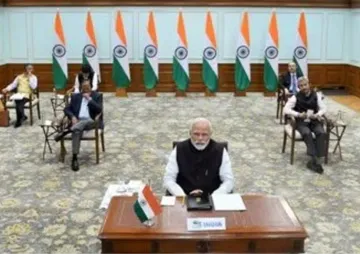
As the pandemic spread, causing extreme human and economic destruction in its wake, the BRICS foreign ministers met via videoconference on 28 April. Besides reiterating the importance of multilateral cooperation and their commitment to it, the five foreign ministers are also reported to have agreed on the creation of a loan instrument of $15 billion for financing economic recovery.
All the above moves could be read as signals of the BRICS to stand together against the coronavirus. But a closer look behind this professed unity is in order.
Behind the BRICS front, divisions rising?
For most coalitions — and especially so when they involve developing countries — there are usually doomsayers predicting its premature death. The BRICS has been subject to such scepticism for many years now, driven partly by the many disparities among the members. The grouping, after all, did bring together a mix of democratic and authoritarian regimes, with very different societal structures, resource bases, developmental trajectories, and historical traditions. The current pandemic has exacerbated pre-existing differences amongst the BRICS. And while the differences are multiple across the various dyads, the most pertinent at this point are those between the most powerful member of the BRICS — China — and the others. I highlight these below.
The BRICS has been subject to such scepticism for many years now, driven partly by the many disparities among the members.
Amidst the cooperation within the BRICS dyads, the smoothest seems to be between China and Russia. For example, at a press conference following the Foreign Ministers’ meeting, Russian Foreign Minister Sergei Lavrov stated, “When we talk about cooperation with China, we cite facts. There are many of them. We are not hiding them from anyone. They include specific forms of assistance: the delivery of humanitarian supplies, medicine and testing kits, medical specialists were dispatched, there were mutual consultations and many more things.” But even in this close relationship, there has been some friction during the pandemic; Russia, for instance, was among the first countries to close its borders to China.
The other dyads with China within the BRICS have run into more visible difficulties. In the case of Brazil-China, as the virus has spread, it has resulted in public finger-pointing and name-calling from both sides. From South Africa, along with other African countries, China has attracted criticism for the ill-treatment that has been meted out to African residents there. Perhaps the most serious set of differences can be found between the once much-touted “Ch-India” dyad. In fact, the distrust between the two countries has deep roots; the military standoff between the two in 2017 at Doklam was indicative of this (BRICS or no BRICS). Two recent sets of reactions by India now indicate how the pandemic has impacted on this already difficult relationship. First, to combat “opportunistic takeovers/acquisitions of Indian companies due to the current COVID-19 pandemic,” India recently put up new restrictions on incoming FDI from neighbouring countries. The new restriction is seen as targeting China, given that both Bangladesh and Pakistan are already subject to such measures. This move drew strong criticism from China. Second, India cancelled the import of Chinese test-kits for Corona on the grounds that they were faulty and had an accuracy rate of 5%. The Chinese spokesperson described India’s behaviour as “unfair and irresponsible.”
The other dyads with China within the BRICS have run into more visible difficulties.
Taken together, these examples are more than just a series of diplomatic “spats”. They come in a context of increasing suspicion about Chinese regional and global ambition. Signs of this ambition can be found in China’s Belt and Road Initiative; the acquisition of the “string of pearls”; adventurism in the neighbouring seas; sabre-rattling on its shared border with India in the last weeks; and the passage of a new security law that seems to make a mockery of the autonomy that had been promised to Hong Kong under the handover agreement. On top of this, one of the big takeaways from the pandemic for many countries has been a recognition that global value chains — and even crucial health supply chains — can be weaponised by countries for their national gain. As a result, despite China’s many efforts at coronavirus diplomacy, this heightened level of concern — and deeper rifts within the BRICS — are likely to be the new normal.
Conclusion
The pandemic has had a perverse effect on the BRICS as a political grouping. It has revealed old faultlines, and exacerbated them further. Within the grouping, other alignments are also emerging. For example, Russia, among the four, seems to be moving closer to China, even as it confronts other major players outside. Brazil and India, in contrast, seem to have come closer together — witness the export of hydroxychloroquine and paracetamol by India to Brazil, and Brazil’s expression of gratitude through a reference to Indian traditions. What do these rifts and realignments mean for the BRICS itself, and for the world at large?
The divisions that the pandemic has exposed within the BRICS create new opportunities for actors that do not wish to become collateral damage in a new cold war.
First, it is difficult to see the BRICS serving as a negotiating platform for its members, given the clear divergence of interests that the pandemic has reinforced. No amount of lip-service to multilateralism can overcome the risks, which this pandemic has brought to the fore, of over-reliance on crucial supply chains that can be weaponised. This risk is even higher when dealing with competitors and rivals, and the Ch-India dyad is indeed one that has involved competition and rivalry for decades. Add to this the discontent expressed by Brazil and South Africa against China in recent weeks, and it is clear that the BRICS grouping is not the united front (e.g. towards the creation of a parallel world order, or even reform the existing world order) that it was envisioned to be. This does not mean that the BRICS will disappear; it does mean though that its limited impact will weaken even further.
Second, thus far, debates on decoupling have focused primarily on the US and China. But the divisions that the pandemic has exposed within the BRICS create new opportunities for actors that do not wish to become collateral damage in a new cold war. For instance, working together with India and South Africa, the EU could chart a third way for like-minded players. Some of the BRICS countries could be valuable allies for the reform of multilateralism, a renegotiation of the bargain on globalisation, and the refurbishment of a liberal world order.
A shorter version of this essay was first published as: Amrita Narlikar, ‘The Politics of the BRICS amidst the Pandemic,’ in Gian Luca Gardini (edited), The World Before and After COVID-19: Intellectual Reflections on Politics, Diplomacy, and International Relations, Salamanca-Stockholm, European Institute of International Relations, May 2020, https://www.ieeiweb.eu/wp-content/uploads/2020/06/Full_book_FINAL_EN2.0-UNIDO.pdf.
As such, my focus is fundamentally different from the plethora of writings on how the pandemic will affect the growth prospects of the emerging markets. For a useful analysis of the economic consequences, see Adam Tooze, ‘The Coronavirus is the biggest emerging markets crisis ever,’ Foreign Policy, 28 March 2020.
Jim O’Neill, Building Better Global Economic BRICs, Goldman Sachs Global Economics, Paper No. 66, 30 November 2001.
Gillian Tett, ‘The Story of the BRICs,’ Financial Times, 15 January 2010.
Oliver Stuenkel, ‘Post-Western World and the Rise of a Parallel Order’. The Diplomat, 26 September 2016.
Ministry of Foreign Affairs of the Russian Federation, ‘Russian BRICS Chairmanship Statement on the Novel Coronavirus Pneumonia Epidemic Outbreak in China’. issued on February 11, 2020 at the 1st Meeting of BRICS Sherpas/Sous-Sherpas in St.Petersburg.
The NDB’s website proudly highlights this achievement: “The Program is NDB’s first emergency assistance program in response to an outbreak in its member countries. The preparation and processing time from the request to NDB by the Chinese Government to the approval of the Program by NDB’s Board is about a month, which is a new record for NDB’s loan preparation and processing time with efficiency and quality, in efforts to ensure the timeliness of the Program and to accommodate the urgency of the outbreak”.
Maha Siddiqui, CNN News-18, ‘BRICS Nations Propose $15 Billion Loan Instrument to Rebuild Coronavirus-hit Global Economy’, 28 April 2020.
Ministry of Foreign Affairs of the Russian Federation, ‘Foreign Minister Sergey Lavrov’s statement and answers to media questions at a news conference following an extraordinary meeting of the BRICS Ministers of Foreign Affairs/International Relations’, Moscow, April 28, 2020.
Alexander Gabuev, ‘The Pandemic could tighten China’s grip on Eurasia,’ Foreign Policy, 23 April 2020.
Bryan Harris and Andres Schipani, ‘Brazil-China ties strained by social media war over coronavirus,’ Financial Times, 21 April 2020.
Simon Marks, ‘Coronavirus ends China’s honeymoon in Africa’, Politico, 17 April 2020.
Ministry of Commerce & Industry, India, Review of Foreign Direct Investment (FDI) policy for curbing opportunistic takeovers/acquisitions of Indian companies due to the current COVID-19 pandemic: Press Note No. 3 (2020 Series), Department for Promotion of Industry and Internal Trade FDI Policy Section, 17 April 2020.
Benjamin Parkin, ‘India moves to curb Chinese takeovers,’ Financial Times, 18 April 2020.
Ameya Pratap Singh and Urvi Tembey, ‘The Logic behind India’s new Investment Policy’, The Diplomat, 22 April 2020.
BBC, ‘India cancels supply of “faulty” China rapid test kits,’ 28 April 2020.
Amrita Narlikar, ‘Regional Powers’ Rise and Impact on International Conflict and Negotiation: China and India as Global and Regional Players,’ Global Policy, 10 (2), May 2019.
Henry Farrell and Abraham Newman, ‘Weaponized Interdependence: How Global Economic Networks shape State Coercion,’ International Security, Vol. 44, No. 1 (Summer 2019), pp. 42-79.
Charles Dunst, ‘Beijing’s Propaganda is finding few takers,’ Foreign Policy, 20 April 2020.
Revathi Krishnan, ‘Like Hanuman got medicine: Brazil’s Bolsonaro invokes Ramayana in Covid-19 letter to Modi’ The Print, 8 April 2020.
The views expressed above belong to the author(s). ORF research and analyses now available on Telegram! Click here to access our curated content — blogs, longforms and interviews.



 PREV
PREV