Very many individuals with myopic vision questioned the relevance of space activities in a newly independent nation which was finding it difficult to feed its population. But the vision of the leaders was very clear : if Indians were to play a meaningful role in the community of nations, they must be second to none in the application of advanced technologies to their real-life problems.
- A P J Abdul Kalam in his autobiography, Wings of Fire
Introduction
India is a country at the cusp of a major transformation. Since early 2000, the Indian internet user base has virtually exploded. It took 20 years to have the first 100 million users online, but the next 100 million users will come in less than three years. To cater to this meteoric rise in demand, it is imperative to look beyond the traditional modes of internet delivery, and as this chapter argues, space-based solutions are necessary.
India: A Country on a Launchpad
Through a series of economic reforms that began in the early 1990s, India was made open for international players in a move that resulted in a rapid and sustained expansion of the economy. Between 1991 and 2015, the Gross Domestic Product (GDP) of the country rose from a modest $200 billion to $2 trillion.2 This impressive growth was chiefly driven by the flourishing
Information Technology (IT) and Information Technology enabled Services (ITeS), as well as a growing industrial sector. Currently, India’s export of software and allied services account for about two-thirds of the $120-130-billion global market. Today, India is also home to research and development centres of many of the major technology companies.
Buoyed by the success of IT and ITeS, Indians are moving out of their comfort zones and embracing entrepreneurship. As of January 2016, India had more than 19,000 technology-enabled start-ups, of which about
5,000 were started in 2015 alone. E-commerce companies have greatly increased the choice of products for the consumers and allowed sellers to reach out to a large number of customers. By bringing in the rural markets to the mainstream, the e-commerce ecosystem has the potential to integrate rural and urban economies. A large number of start-ups working on the Internet of Things (IoT) are trying to hook up sensors and generate a data deluge. Cashing in on the rising awareness about the electronic payments are financial technology companies building digital wallets that enable the seamless flow of money among various stakeholders.
Government’s ‘Digital India’ programme envisions to “transform India into a digitally empowered society and knowledge economy”. The government intends to achieve this by focusing on three vision areas, namely:
1) Digital Infrastructure as a Core Utility to Every Citizen; 2) Governance and Services on Demand; and 3) Digital Empowerment of Citizens.
In a nutshell, both the government and the private sectors are working together to take India to the next level. However, for India to take off from the launchpad, internet connectivity is the fuel—connectivity not just in cities but reaching the end points of the country.
India in Space
India has been an active player in space and has always utilised space for improving the quality of life of its people. It is one of the few countries in the world that have the capability to develop indigenous technologies to carry out space missions.6 In 2014 the country joined an elite club by successfully launching a Mars Orbiter in its very first attempt and at a relatively lower cost. After its establishment in 1969, the Indian Space
Research Organisation (ISRO) has developed significant expertise in building satellites for various applications including remote sensing, communication, weather forecasting, and national security. India’s indigenous launch vehicles, the Polar Satellite Launch Vehicle (PSLV) and the Geo-Synchronous Launch Vehicle (GSLV) have earned a name for their reliability in the global launch services market. As of September 2016, PSLV had successfully placed 121 satellites into low earth orbit, of which, 79 are from countries other than India. Every year, updates provided by ‘eyes in the space’ have helped save thousands of lives in times of extreme weather events like a cyclone. Remote sensing data provided by ISRO satellites are helping researchers across the country to understand the impact of climate change on the local environment. There also have been efforts to leverage satellite communication technologies for making quality education and healthcare available to people living in the remotest villages.
However, satellites can play a much bigger role in India’s ambition to transform itself into a country empowered by digital technologies. Sustained efforts of global space organisations to build capability in space has created the required talent and companies across the globe, including in India, that are capable of taking private space to its version
2.0. ISRO is encouraging private industry to transform themselves from manufacturer of parts to becoming full satellite integrators and manufacturers. There is enough expertise in India and globally to create multiples of these organisations and serve the needs of the growing satellite industry. In light of this development, several companies including start- ups have ambitious plans to build viable and sustainable businesses solving real problems.
Taking the Internet to the Villages
India faces various hurdles as it aims to transform itself into a technologically developed nation. With an estimated 462 million internet users online, India has the second largest internet user base after China. But, with more than 65 percent of the population without access to internet connectivity, India’s task is difficult.10 Internet penetration in the US, for example, is at 88.5 percent; Japan is at 91.1 percent, and China, 52.2 percent. However, what stands out for India is the rate of growth. Between 2015 and 2016, the number of internet users in India increased by 30.5 percent—a growth that is unheard of in any other country in the world in the same period. The high growth rate can largely be attributed to the fact that more than half of India’s population is below 25 years of age. Further, the growth is not limited to the number of users; the demand for data, especially over mobile phones, is also growing at a much faster rate all over the world. By 2020, monthly global mobile data traffic is expected to reach 30.6 exabytes from 3.7 exabytes in 2015.11
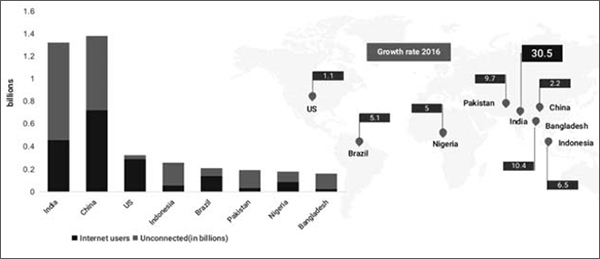 Figure: Internet’s growing demand
The internet user growth so far has been skewed towards urban areas even though majority of the population resides in rural areas. The main reason for this disparity is low population density in rural areas which makes it difficult for traditional internet solutions to recover the cost. However, there has been a growing demand for internet in urban and rural areas alike. By 2018, India is expected to have more than 500 million internet users, and about half of them will come from rural areas.12
Recognising the socio-economic dividends of broadband internet, in 2011, the Indian government rolled out an ambitious project to connect 250,000 village panchayats with optical fibres. The project, initially called National Optical Fiber Network, and later renamed Bharat-Net 2015, is expected to facilitate transition to e-commerce, e-Banking, e-Governance, e-Education, and Tele-medicine. At the time of writing this chapter, the project had reached 15,624 village panchayats.
All the major internet service providers in India are also making large investments into expanding their existing infrastructure to get ready for the expected growth. Bharti Airtel, for instance, is committed to expanding its mobile broadband coverage to all Indian towns and 750,000 villages.
Reliance Jio, a relatively new player into the country’s telecom market, has made large investments to create fibre optic-based 4G infrastructure to provide telecom internet service across India. However, their coverage capacity is strongly linked to the population density of a region.
Limitations of Optical Fibres
Optical fibre, along with wireless infrastructure mounted on towers, form the core of ground infrastructure required to provide broadband connectivity. In fact, there are long cables on the ocean bed connecting continents and transmitting large volumes of data at very high speeds. Similar fibres, laid underground, are also used to deliver broadband internet to homes and businesses in cities and towns. Optical fibres, though reliable, turn out to be expensive when they are used to connect regions of low population densities. It costs about $3,000 to lay optical fibre for a length of one kilometer. Thus, if there are not enough consumers, recovering capital costs becomes a challenge. Since a significant portion of the Indian population that is yet to come online lives in semi-urban and rural areas, it may not be economical to lay optical fibres in some of those regions. Also, developing ground infrastructure is an incremental process—it is not possible to provide connectivity to a village unless its surrounding areas are already connected. Therefore, providing high-bandwidth internet to such a large, widely distributed population creates a need to look beyond the ground infrastructure. Space technology may yet have all the answers.
Beaming Internet from Space
Satellite internet provides an economical solution to most of the challenges faced by ground infrastructure. Optical fibres bring in higher capacity in a concentrated fashion, while space-based technologies are effective at distributing capacity over a large area. Calculations show that the cost to cover one sq km from space varies between $1.5 and $6, which is negligible as compared to $3,000 to $30,000 required by ground infrastructure to cover the same area. Moreover, accessing space-based internet is as simple as getting DTH television services—all a consumer needs is an antenna on the rooftop, and a set top box inside the house.
Satellite infrastructure also complements the ground internet network. Areas where ground infrastructure is difficult and cost-intensive to penetrate,
satellite infrastructure can easily cover. Moreover, it also frees ground infrastructure from the burden of being incremental as telecom towers with satellite as backbone can now be deployed in new areas without worrying about surrounding infrastructure. Owing to the minimal surrounding infrastructure required when telecom towers uses satellite as backbone, it expedites the return on investment for ground infrastructure.
In countries like India, satellite infrastructure can also reduce congestion in already overloaded networks, and thus improve the quality of service provided by mobile networks. They can be integrated into 5G systems, and help take advanced IoT applications to regions that are beyond the reach of terrestrial networks. Satellite systems are universal, too—in fact no other broadband technology promises quality coverage in urban, semi- urban, remote and mountainous regions. It can also provide internet on oceans and islands, and even to those in the sky.15
In addition to these, trends on the space technology front imply that the time is right for making high-bandwidth internet from space a reality. Because of significant improvements in rocket technology, the launch costs have come down over the last few decades. For instance, with India’s Geosynchronous Satellite Launch Vehicle (GSLV - 3) the cost of launching a kilogram of material to space is expected to be just a third of the cost with the PSLV launcher. This is highly encouraging news for this industry.
For these reasons, even the International Telecommunication Union/ UNESCO Broadband Commission for Broadband Development, makes the following observation in its report The State of the Broadband 2016.16
“Satellite systems should be given full consideration as solutions for next-generation broadband network deployments in rural and remote areas, as well as in diverse environments and deployment scenarios.”
In simple terms, terrestrial technologies are commercially viable in the densely populated urban areas, while satellite internet provides a better business case for sparsely populated regions.
A Framework for Beaming Internet from Space
In principle, just a few High Throughput Satellites (HTS) are sufficient to cover a country as vast as India and provide high-bandwidth, high-speed,
reliable internet. These high-throughput satellites can be placed in Low Earth Orbit (LEO), Middle Earth Orbit (MEO), and Geosynchronous Earth Orbit (GEO) orbit. The lower orbits have substantially lower latency than the higher orbits but they require a higher number of satellites to cover the same area. Lower latencies are absolutely necessary for good- quality internet. Since satellites LEO and MEO are moving constantly with respect to ground, they take turns to serve specific regions on Earth. Some ground infrastructure, called ‘ground nodes’, are required to connect to the servers on Earth.
A constellation of about 150 satellites will be sufficient to cover most of the developing countries whose internet demand is growing rapidly. From a business perspective, these countries represent a huge opportunity which can be tapped by satellite internet as it offers higher penetration rates. This is the plan for Astrome, a start-up incubated at the Indian Institute of Science (IISc), Bangalore.17 Astrome’s HTS, which act as ‘floating routers’, will orbit the earth in LEO at about 1,400 km from the Earth’s surface. With this in place, it is possible to provide a bandwidth of 50 megabytes per second to home users, and 400 megabytes per second to business users, for both downloads and uploads. Since bandwidth depends only on the satellite, the location of the user does not matter—for a given cost, consumers in either a big town or a tiny Himalayan hamlet will get the same bandwidth.
Pervasive Internet: What can it enable?
Access to broadband is a “vital enabler of economic growth, social inclusion and environmental protection”.18 By improving connectivity, a reliable broadband coverage has the potential to transform a country. A World Bank study estimates that a 10-percent increase in broadband connectivity in a country can increase its GDP by 1.38 percent.19 In the case of India, research has shown that 100-percent internet connectivity by 2020 can add an extra $1 trillion to its GDP.20 These economic benefits are accrued from dramatic changes in the way people connect with each other, the government, and businesses. With the advent of pervasive internet, as promised by the proliferation of satellite internet technologies, one can expect dramatic transformations in the way some of the essential services are delivered. At the same time, internet also opens up a plethora of opportunities for start-ups to develop technology-enabled products and services that cater to various sections of people.
- Catalysing business: With quality internet, people living even in far flung areas can also avail banking services through their mobile phones, and benefit from the financial security that comes with it. In fact, in 2015 alone, mobile internet contributed $3.1 trillion to global GDP, and lifted millions out of poverty.21 In India, in 2013, the internet economy contributed $60 billion or 2.7 percent of the country’s GDP, and by 2020, the contribution is expected to reach four percent. Internet is fast becoming a critical resource for Indians. A rural entrepreneur from Gujarat, for example, has improved his wood block painting business by promoting his products on a Facebook page. An enterprising farmer from Sangli, Maharashtra, once rallied 25,000 farmers on Facebook to stop the crashing of turmeric prices in the local market. A Bangalore-based mobile phone store has managed to reach out to customers in far-off states like Assam and Jammu & Kashmir through its association with e-commerce companies. In urban localities, tens of millions of users are making transactions on consumer-to-consumer portals. By 2018, around 8 million market-place websites are expected to be using the internet to connect to customers online, and the internet economy is expected to create 1.5 to 2 million jobs.23 With 160 million active users every month, India is the largest market for WhatsApp, and many of these users get on WhatsApp to sell their goods to customers who they will otherwise not have access to. The Indian government is also making a strong push towards building a digital economy by encouraging cashless transactions. The direct electronic transfer of subsidies to the bank accounts of millions and millions of citizens is just an example for how state-of-the-art technologies can help reduce corruption and improve governance. Recently, the government also released the Unified Payment Interface (UPI), a payment system that facilitates seamless fund transfer between two bank accounts.25 The app does not require bank account details and sending money is claimed to be as simple as sending a text message. The government has also released Aadhar Payment App, an application which enables merchants to receive payments from customers who do not have a mobile phone, but have the Aadhar number. This app uses fingerprints for authentication, and requires a decent internet connection.26 With satellite internet, this revolutionary app can be made usable in every nook and corner of the country. Apart from these apps, the government has also introduced RuPay, a debit card which comes with lesser transaction costs as compared to other cards in the market. The Indian entrepreneurial ecosystem is also cashing in on the opportunity by coming out with various fund transfer apps, each with its own flavour.
- Education: In absolute numbers, Indian higher education system is the third largest in the world, next only to the US and China. However, only a few educational institutions of higher learning are equipped with infrastructure for delivering quality education. The IITs, which are known globally for their quality training, cater only to less than ten thousand students. High-speed broadband internet can take learning materials even to those who cannot attend these elite institutions. Scores of students and professionals learn new skills through popular educational websites like MIT Open Courseware, and online platforms like edX which connect learners to the best universities in the world. The National Program on Technology Enhanced Learning (NPTEL), a joint initiative of the IITs and the IISc, is creating hundreds of Massive Open Online Courses (MOOC) to which students can enrol and get certified in various subjects. Free and Open Software in Education (FOSSEE), part of the National Mission on Education through Information and Communication Technology (ICT), Ministry of Human Resources and Development, is enabling students to improve their computational skills by learning new free and open source tools online. The reach of such relevant and ambitious programmes is hindered by the absence of internet in many of the smaller towns and villages in the country. Satellite internet can go a long way in taking these initiatives to the doorstep of every learner in the country.
- Healthcare: Like education and finance, healthcare is a basic service that must be easily available to every citizen of the country. However, a single statistic puts India’s healthcare system in perspective: only two percent of the country’s doctors cater to the rural areas, which are home to 68 percent of the total population. Public health centres are understaffed, and often, are too distant to be visited by many villagers. With the availability of satellite internet, specialist doctors can remotely monitor patients and help in early diagnosis of various medical conditions. The availability of such preventive healthcare facilities can also have a positive effect on the finances of rural households.
- Smart Cities: Cities around the globe are becoming hubs of economic activity. They occupy two percent of the total land area, accommodate more than half of the world’s population, account for 70 percent of global GDP, consume 60 percent of global energy consumption, emit 70 percent of greenhouse gases, and produce 70 percent of total waste.Obviously, managing cities is becoming a challenge to all governments. The Indian context gets more complicated because of the wide economic disparity among the urban middle class and the urban poor. The government’s Smart Cities Mission aims to leverage state-of-the-art technology to improve the quality of life in the country’s crowded cities. The smart cities, among other things, are thought to be brimming with sensors that constantly monitor water and electricity supply, air pollution levels at designated areas, and flag concerned officials automatically. These sensors require internet connectivity to communicate among themselves and to the central server that transforms raw sensor data into actionable insights. Though urban areas are covered by optical fibres, satellite internet can be used as a backup when the primary network breaks down in case of an emergency.
- Smart Agriculture: Agriculture, the sector which employs about half of India’s workforce, provides plenty of opportunities for technological intervention at various stages. Sensors that can measure moisture content in the soil can ensure that the crops are grown at the right moisture level, and can also help save water in large quantities. Video surveillance systems can help farmers monitor their agricultural lands electronically. India is second largest in the world in terms of farm output. Yet it also loses a significant proportion of its produce to waste, due to poor storage and transportation facilities. Technology solutions can be developed to centrally monitor storage facilities scattered across the country. Tracking of vehicles that transport agricultural produce can also go a long way in improving the overall logistics of the agriculture sector. A pervasive internet can enable these interventions in a sector that forms the backbone of the rural economy.
What Needs to be Done?
The proliferation of broadband has helped improve the quality of life of people across the globe. Mobile phones, with their astounding penetration rates, are becoming the most popular mode of accessing the internet. The need of the hour is to make high-bandwidth, broadband internet universally available in India. Experience has shown that “value is shifting away from connectivity towards a portfolio of mobile-enabled services”.31 Thus, governments and private entities should create applications that are tailored to the needs of different sections of people. Also, various stakeholders should come together to increase awareness about the utility of broadband by conducting awareness campaigns, training programmes, and developing and hosting content in local languages. This could be a particularly challenging task in India because of the country’s inherent cultural and linguistic diversity. A number of start-ups have already risen up to this challenge by creating visual apps and content in local languages.
Internet connectivity is not a game changer by itself. What it provides is the basic infrastructure for developing technology solutions that solve real issues faced by a large number of people. At the same time, it opens a great opportunity for entrepreneurs to develop solutions to serious challenges in critical sectors like financial services, education, healthcare, and agriculture. Without such specific solutions, the power of the internet as an enabler of socio-economic change is not fully realised.
Some changes are needed at the policy level, too. ISRO has laid a strong foundation for the Indian space programme. It is high time that the government drafted policies to enable the private sector to build on ISRO’s pioneering work, and build products and services not only for India but for the entire world. The country’s experience in other sectors, especially in telecommunications, has only shown that private sector participation ultimately results in better services to the consumer. In the case of space, private players may well relieve ISRO of creating routine missions.
Conclusion
Robust economic growth over the last few decades, increased investments into R&D, and proactive policies have helped India to embark on a journey of technological transformation. As the country prepares itself for the road ahead, it should first address the wide disparity in the availability of technology to its citizens. Making high-bandwidth, broadband internet available to everyone is one of the best ways to make technology more democratic. However, ground infrastructure may not be the best choice for some of the rural and remote areas of the country.
This chapter argues that the time is ripe for leveraging satellite internet, a technology that is unparalleled in its reach and reliability. Pervasive internet, delivered from space, has the potential to transform the way basic services like banking, education, and healthcare are delivered to citizens of the country. Of course, for a country that has a tradition of utilising space technology for social good and progress, beaming internet from space could well be the next obvious step.
ENDNOTES
1. Alpesh Shah, Nimisha Jain, and Shweta Bajpai, “[email protected] - Creating a $200 Billion Internet Economy”, Boston Consulting Group, January 2015, http://company.mig.me/wp-content/uploads/2015/09/ bcg-report-on-Indian-internet.pdf.
2. "GDP (Current US$) - World Bank National Accounts Data, and OECD National Accounts Data Files,” The World Bank , http:// dworldbank.org/indicator/NY.GDP.MKTP.CD?locations=IN.
3. Ministry of External Affairs, Government of India, Economic Diplomacy Division,”India in Business - IT & ITeS,” http://indiainbusiness.nic.in/ newdesign/index.php?param=industryservices_landing/395/3.
4. Ministr y of Finance, Government of India,”Economic Outlook, Prospects, and Policy Challenges”, http://indiabudgnic.in/es2015-16/ echapter-vol1.pdf.
5. "Vision and Vision Ar eas,” Digital India Programme , http://digitalindia.gov.in/content/vision-and-vision-areas.
6. Narayan Prasad, “Is India Turning a Blind Eye to Space Commerce?,” NewSpace India, accessed Fe br uar y 7, 2017, http:// www.newspaceindia.com/is-india-turning-a-blind-eye-to-space-commerce.
7. Narayan Prasad Nagendra, “Industry Participation in India’s Space Program: Current Trends and Perspectives for the Future,” Astropolitics 14, (2016): 237–55, doi:10.1080/14777622.2016.1244759.
8. Indian Space Research Organisation, “Climate & Environment,” http://isro.gov.in/applications/climate-environment-0.
9. Indian Space Research Organisation, “Tele-Education,” http://isro.gov.in/ applications/tele-education.
10. "Internet Users by Country (2016),” http://www.internetlivestats.com/ internet-users-by-country/.
11. Cisco, “White Paper: Cisco VNI Forecast and Methodology, 2015-2020,” http://www.cisco.com/c/en/us/solutions/collateral/service-provider/ visual-networking-index-vni/complete-white-paper-c11-481360.html.
12. Ibid, <1>.
13. Bharat Broadband Netwo rk Limited, “Background,” http://www.bbnl.nic.in/index1.aspx?lsid=48&lev=2&lid=45&langid=1.
14. Broadband Commission, “The State of Broadband 2016: Broadband Catalyzing Sustainable Development”, September 2016, http://org/Documents/reports/bb- annualreport2016.pdf.
15. Ibid, <15>.
16. Ibid, <15>.
17. Astrome, “Home,” http://www.astrome.co/.
18. Ibid, <15>.
19. Ibid, <14>.
20. Rajeswari Pillai Rajagopalan and Sriram Jayasimha, “Non-Geostationary Satellite Constellation for Digital India,” ORF, https://www.orfonline.org/ expert-speaks/digital-india-non-geostationary-satellite-constellation/.
21. Ibid, <15>.
22. Ibid, <1>.
23. Ibid, <1>.
24. Manish Singh, “WhatsApp Hits 160 Million Active Users in India, Its Big g est Market,” Mashable, http://mashable.com/2016/11/15/ whatsapp-160-million-monthly-active-users-india/.
25. BHIM & SBI Pay UPI Apps, “What Is UPI App or Unified Payment upi-payment-system/.
26. BHIM & SBI Pay UPI Apps, “Aadhaar Payment App: Benefits, Requirement and Comparison,” https://upipayments.co.in/aadhaar- payment-app/.
27. National Payments Corporation of India, “National Payments Corporation of India,” http://www.npci.org.in/RuPayBenefits.aspx.
28. NPTEL, “NPTEL Online Certification,” http://nptel.ac.in/noc/.
29. FOSSEE, “Free and Open Software in Education (FOSSEE),” http://fossee.in/resources.
30. Ibid, <15>.
31. Ibid, <15>.
The views expressed above belong to the author(s). ORF research and analyses now available on Telegram! Click here to access our curated content — blogs, longforms and interviews.



 PREV
PREV